
Introduction
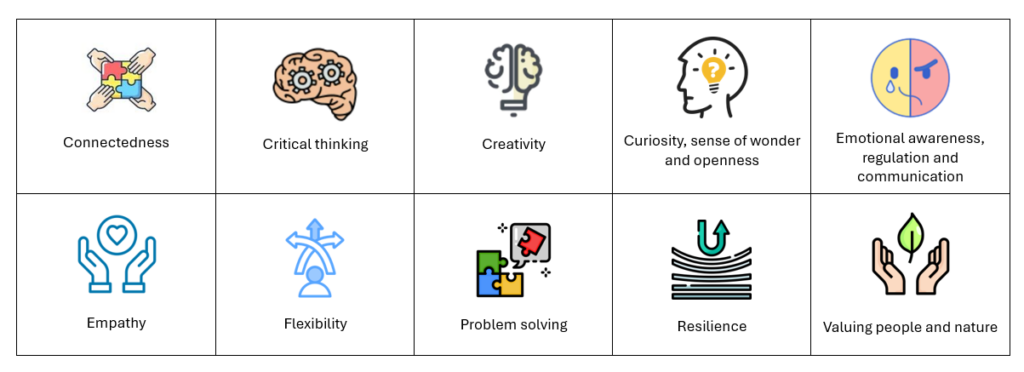
Welcome to the extended introductory module on the ten SPIRIT transversal skills. This document is intentionally more in-depth and reflective. It is designed to prepare you not only cognitively but professionally and personally for the dedicated training program.
The SPIRIT framework is grounded in a holistic understanding of education. Education is not limited to knowledge acquisition. It is a developmental process that integrates cognitive growth, emotional regulation, relational competence, ethical awareness, and identity formation. Transversal skills are the connective structure that allows these dimensions to interact coherently.
In this preparatory reading, you are invited to move beyond the question ‘What subject do I teach?’ and enter the deeper reflection: ‘Who are my students becoming through my teaching?’
What to Expect
This introductory training material is the first core module of the four-module professional training program for in-service teachers, developed by the SPIRIT project. The other three modules will become really useful once you get familiar with this module, as they all focus on the practical development of the 10 transversal skills described in this module. All four training modules have been structured so that the face-to-face workshops are not about theory, but about thinking together and sharing experiences.
The following material, which we would like you to read before the workshop, introduces the theoretical, developmental, and pedagogical foundations of the ten SPIRIT transversal skills. It prepares you to engage actively and critically during the face-to-face training session.
- A conceptual clarification of transversal skills within contemporary educational theory.
- An analysis of why these competencies are central in the 21st century for the future well-being.
- A detailed presentation of the ten SPIRIT skills with practical classroom examples.
- An exploration of developmental levels and behavioral indicators.
- A pedagogical connection to experiential learning theory (Kolb).
- Reflective prompts to analyze your own teaching practice.
You are encouraged to read actively. Underline ideas that resonate. Note questions. Identify areas where your practice already aligns with these principles and areas where growth may be possible.
Learning Objectives
By the end of this preparatory study, you will be able to:
- Define transversal skills within a theoretical educational framework.
- Explain why competence-based education is increasingly emphasized globally.
- Describe each of the ten SPIRIT transversal skills in depth.
- Identify observable behavioral indicators for each skill.
- Understand how skill development supports long-term well-being and life satisfaction.
- Apply Kolb’s experiential learning cycle to classroom situations.
- Critically reflect on your own role as a model of transversal competence.
Before the workshop
Workshop activities
After the workshop
Read
Do
Watch
Additional OER
Have a good learning journey and have fun discovering this really fascinating topic