
Learning outcomes
- Participants identify the appearance of transversal skills in concrete/case study learning situations.
- The participant will be able to reflect on the applicability of the approach in their own practice
- Give participants a first taste of the comprehensive effects of the 3 tools developed as a significant outcome of the project, in order to a) make them aware of the purpose of the three tools for skills development; b) enable them to understand the relationship between SPIRIT skills and the tools through three case studies.
- By achieving the above described learning objectives, prepare the participants to attend further modules of the training
Detailed description
Group works
The trainer presents three short classroom case studies/learning situations (these three case studies are in accordance with the three development tools proposed, developed, and summarised by the project partners in the toolboxes: learning activity; games/gamified learning; and STEAM). The participants analyse the three cases in 3 small groups using the following questions:
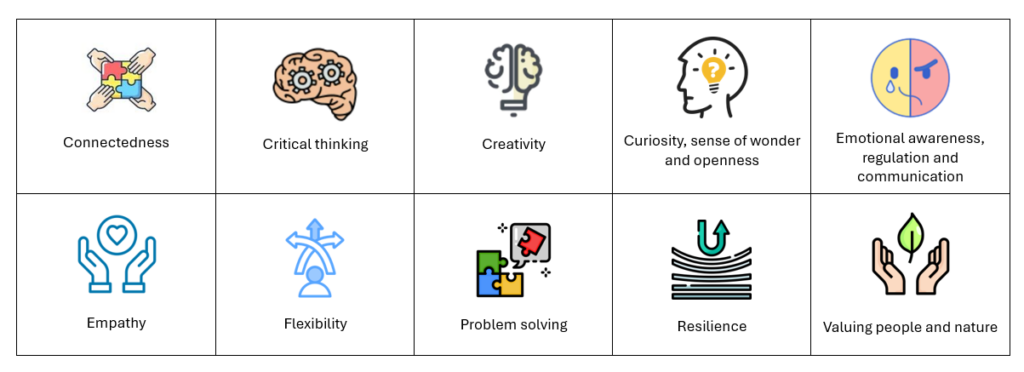
- Which transversal skills appear in the situation? How do they appear?
- How does the teacher support the development of these skills?
- What else could the teacher do to further support these skills?
Each group prepares a short summary.
Plenary discussion
Groups discuss their responses and briefly share their conclusions with the whole group. The trainer will highlight how the teacher’s role is reflected in the situation, for example, by asking questions, organising group work, assigning roles and encouraging learners.
Time allocation
- Presentation of the case: 10 minutes
- Group analysis: 20 minutes
- Plenary discussion: 10 minutes
Total: 40 minutes
Required materials
- case description
- flipchart
- other stationary – post-its, markers
Handouts
Pay attention – Important note
The success of Activity 3 may depend largely on the choice of case study/learning situation. Be aware that the handouts provided here are only a sample and a suggestion. They are of course, perfectly suitable for use in training. It is very important that each case/learning situation is directly linked to one of the three tools. Choose a learning scenario that is in line with the experiences and needs of the participants. Use the toolkits for selection