
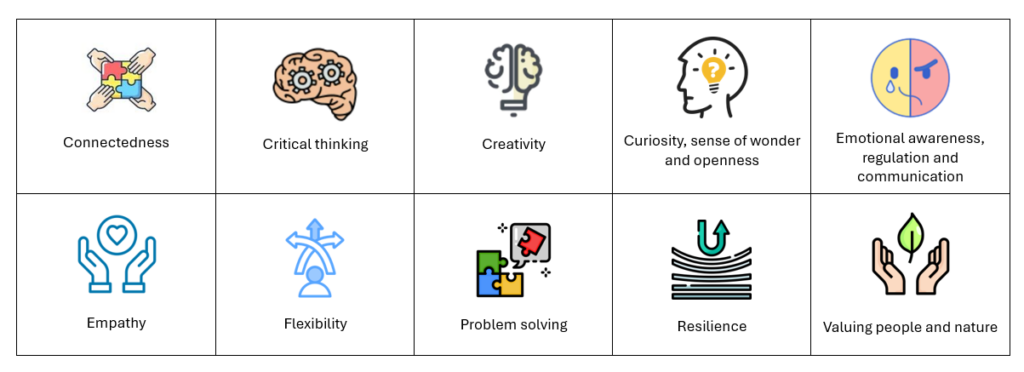
How do we develop students’ skills by demonstrating through our behaviour what it means to behave in a way that is appropriate to a particular skill?
With this exercise, we want to highlight how important it is for the development of SPIRIT skills for the children to see consistent and authentic behaviour of adults/teachers. For example, the teacher’s verbal and non-verbal communication is consistent when he/she wants to reinforce to the student that making mistakes is not a problem, it is part of learning. Or when the teacher communicates his/her feelings honestly, showing that emotions can be realised and communicated.
Learning outcomes
Participants recognise that teachers’ behaviour has a continuous and implicit impact on students’ development of transversal skills. Participants are able to identify concrete, observable forms of teacher modelling behaviour. Participants connect students’ behaviours and teachers’ modelling practices to the SPIRIT transversal skills.
Detailed description of the activity – Steps of the activity
1) Thought-provoking trigger – trainer intro, brainstorming and group discussion
To introduce the topic, the trainer presents a short classroom scenario: “Imagine a student makes a mistake and the teacher responds: ‘This is not correct. Pay more attention.’ What does the student learn from this situation – beyond the task itself?” Participants briefly share a few reflections. The trainer uses this moment to highlight that students constantly learn from how teachers respond and behaviours, not only from what they teach.
2) Group work – Identifying modelling behaviours
Participants work in their groups of four. The groups should remain the same as the ones we set up in Activity 1. Keep the participants in flow and do not change the group membership. Each group selects (or gets) one (or two) SPIRIT skill card. Their task is to analyse the skill on three levels:
- Student behaviours: What observable behaviours indicate that the skill is present? (e.g. for empathy: listening to peers, responding to others’ feelings)
- Teacher modelling behaviours: What does the teacher do that supports this skill? (e.g. for empathy: active listening, acknowledging emotions).
- In what classroom/teaching situation can/should I demonstrate the existence of my SPIRIT skills through my behaviour?
Each group prepares a short, structured flip-chart poster about each skill (e.g. in a three-column format): Skills (rows) – Student behaviour (column 1) – Teacher modelling (column 2) – Teaching/learning/Playing situation (column 3).
| Student behaviours: What observable behaviours indicate that the skill is present? | Teacher modelling behaviours: What does the teacher do that supports this skill? | Classroom/teaching situation, can/should I demonstrate the existence of my SPIRIT skills through my behaviour | |
 Emotional awareness, regulation and communication | |||
 Curiosity, sense of wonder and openness | |||
…………………….. |
3) Gallery walk exercise
is an active, collaborative learning activity where the learner/training participants rotate around the classroom/training room to view, analyse, and discuss displayed individual/peer/group work, often leaving feedback on notes. It promotes movement, higher-order thinking, and peer-to-peer interaction.
Each of the prepared posters is displayed on the wall. The groups walk around, read what is written, discuss what they have read in groups, and add their own thoughts using post-it notes. Then, at the trainer’s signal, they move on to the next poster
4) Plenary discussion
Groups briefly present one key example. The trainer facilitates a short synthesis by clarifying and refining participants’ ideas, highlighting strong examples, and drawing connections between contributions. The trainer may organise the responses on a flipchart using a simple structure: Skill – Student behaviour – Teacher modelling. The trainer concludes the activity by emphasising the key insights. Teachers continuously model behaviours even unintentionally. Transversal (SPIRIT) skills are largely developed through observed behaviour patterns in learning situations. Teacher behaviour creates the framework within which student behaviour develops. Conscious pedagogical presence contributes significantly to students’ emotional safety, well-being, and social development. A possible closing statement: “Students do not primarily learn what we teach, they learn how we are present with them.”
Time allocation
- Thought-provoking trigger – trainer intro, brainstorming and group discussion: 15 minutes
- Group work – Identifying modelling behaviours: 20 minutes
- Gallery walk: 20 minutes
- Plenary discussion: 15 minutes
Total: 70 minutes
Required materials
- flipchart
- markers
- post-it notes
- SPIRIT skill cards