
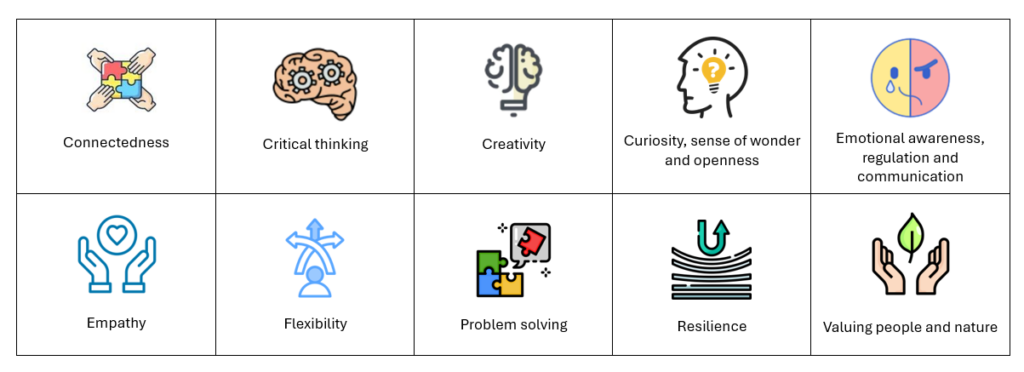
Check in and Introduction: Reflecting on Teachers’ Own Experiences of Skills Development. Own experience on the spot, teamwork, guided small group, and plenary discussion on the possibilities, skill development in the classroom
Learning outcomes
The participant is able to formulate professionally grounded arguments supporting the necessity of SPIRIT transversal skills development in primary education (ages 6-10).
Participants understand the concept of the SPIRIT transversal skills and their importance in the learning process.
Introduction: 0-10 minutes
The trainer briefly welcomes the participants and introduces themselves. Participants are then invited to briefly introduce themselves as well (name, grade level they teach, place of teaching, and years of professional experience). After the introductions, the trainer presents the overall structure and objectives of the training programme. Participants are then asked to form four groups of four people. Group formation can be supported by a short icebreaker activity, such as: choosing coloured cards, selecting an inspiring quote, or choosing a skill that most frequently appears in their teaching practice. Participants who select the same element form a group.
Detailed description of the activity
The trainer introduces the concept of transversal skills through a short presentation. During the presentation, the trainer discusses: the definition of transversal skills, several important examples, and their role in the learning process. It is important to emphasise that these skills are interconnected and often appear simultaneously in learning situations.
Group work – Skill sorting activity using the Jigsaw method
Following the short introduction, participants take part in an interactive, collaborative skill-sorting activity. The aim of the task is to help participants interpret transversal skills not as abstract concepts but as elements connected to real pedagogical situations and future skill demands. The activity uses the Jigsaw method, ensuring that participants build a complete understanding by relying on each other’s knowledge. The trainer prepares four types of cards in advance:
- Skill cards containing the names of the ten transversal skills,
- Definition cards describing the meaning of each skill,
- Learning situation cards describing short primary classroom scenarios,
- Future-oriented cards explaining why the skill is important for the future (for example for learning, collaboration, or future work contexts)
Steps of the activity
- Participants begin working in groups of four (home groups). Each group receives a skill card and briefly discusses: what the skill means in their own teaching practice, and in which classroom situations they have encountered it. Participants then reorganize into expert groups, based on the type of card they have received.
- Four expert groups are formed: skill cards, definition cards, learning situation cards, future-oriented cards. Each expert group reviews and interprets its cards together and prepares to explain them to others.
- After this phase, participants return to their home groups, where each member brings different information: one brings the skill, one the definition, one the learning situation, one the future perspective. The group’s task is to assemble the full interpretation of the skill by: matching the skill with the correct definition, identifying a corresponding classroom situation, and connecting it to its future relevance.
- Groups formulate a short explanation of how the skill appears in primary education and why it is important for students’ future development.
- Finally, groups present their results to the whole group.
The trainer highlights that transversal skills rarely appear in isolation but rather in interconnected ways, and that teachers play an important role in supporting their development through: thoughtful questioning, structured learning activities, and supportive feedback.
Plenary discussion
The trainer facilitates a short plenary reflection in which participants identify key pedagogical patterns. For example, participants may notice that certain skills – such as collaboration, empathy, or problem-solving – often appear in the same types of learning situations.
Time allocation
- Introduction: 10 minutes
- Presentation: 15 minutes
- Group work: 30 minutes
- Plenary discussion: 15 minutes
Total: 70 minutes
Required materials
- skill cards
- definition cards
- learning situation cards
- poster templates
- post-it notes