
Activity 1 – Check in and Introduction: Reflecting on Teachers’ Own Experiences of Skills Development
Own experience on the spot, teamwork, guided small group, and plenary discussion on the possibilities, skill development in the classroom
Learning objective to be achieved
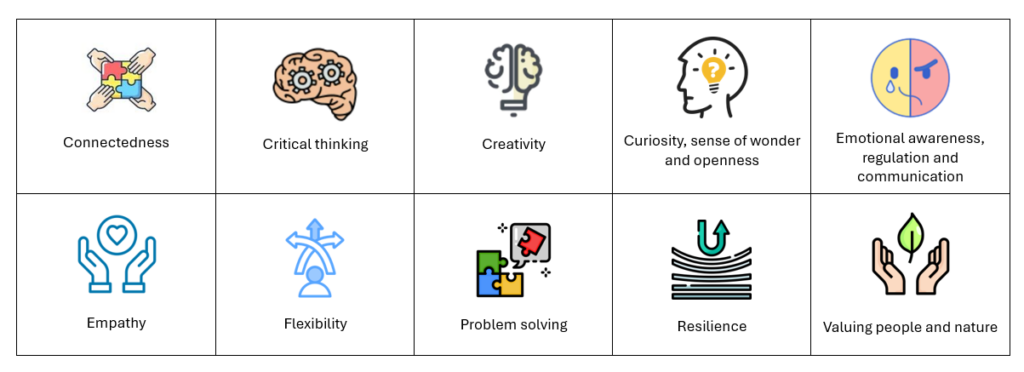
Participants recognise, based on their own teaching experiences, that the SPIRIT 10 transversal skills are already present in classroom situations.
Activity/exercise in details
Explain the purpose of the training – not the procedure – and the rules. Write the rules on a flip chart and put it on the wall so that all participants can see it.
Introduction: 0-10 minutes
The trainer briefly welcomes the participants and introduces themselves. Participants are then invited to briefly introduce themselves as well (name, grade level they teach, place of teaching, and years of professional experience). After the introductions, the trainer presents the overall structure and objectives of the training programme. Participants are then asked to form four groups of four people. Group formation can be supported by a short icebreaker activity, such as: choosing coloured cards, selecting an inspiring quote, or choosing a skill that most frequently appears in their teaching practice. Participants who select the same element form a group.
Sharing pedagogical experiences on how the transversal skills defined in the SPIRIT model appear in the learning process.
Participants reflect on their own teaching experiences and consider how the transversal skills defined in the SPIRIT model appear in the learning process. During the discussion, the trainer briefly highlights that these skills are not only important for academic achievement but also play a key role in students’ mental health, well-being, and social adaptation. Skills such as emotional awareness, cooperation, or perseverance help children: cope with challenges more effectively, build relationships with peers, and adapt more flexibly to changing learning and life situations. Therefore, during the training, participants reflect not on transversal skills in general, but specifically on how SPIRIT skills appear and can be developed in learning situations in primary education.
Steps of the activity – Snowball technique
Use the “Snowball technique” methods
- Individual reflection (5 minutes): Participants recall a classroom situation in which one or more transversal skills appeared.
- Pair discussion (7 minutes): Participants share their examples with the colleague sitting next to or opposite them.
- Small-group discussion (8 minutes): Two pairs join together and compare their experiences.
- Each group formulates a shared conclusion, which is later presented during the plenary discussion.
Suggested themes and guiding questions
The trainer may support participants’ thinking with guiding questions. These help teachers identify the appearance and pedagogical significance of SPIRIT skills in concrete learning situations.
- Questions for individual reflection
- What classroom situation comes to mind in which students worked together on a task?
- What behaviours indicated that a SPIRIT skill (e.g., cooperation, empathy, creativity, perseverance) was present?
- How did students react when they encountered difficulties or disagreed with one another?
- What did the teacher do in that situation that helped students solve the problem?
- Questions for pair discussion
- Which SPIRIT skills were most visible in the situation you described?
- How could these skills be recognised in students’ behaviour?
- How did the teacher support the development of these skills?
- How does this situation relate to students’ well-being or emotional safety?
- Questions for small-group discussion
- In what kinds of learning situations do SPIRIT skills most often appear in primary education?
- Which skills tend to appear together during the learning process?
- How do these skills contribute to students’ mental well-being and social relationships?
- What pedagogical tools can support the development of these skills in the classroom?
Plenary discussion
Groups briefly present their conclusions. The trainer writes key ideas on a flipchart. Example guiding questions: What learning situations allowed these skills to appear? What role did the teacher play in these situations?
Timing
- Introduction and group formation: 10 minutes
- Snowball activity: 20 minutes
- Plenary discussion: 10 minutes
In total – 40 minutes
Materials
Post-its, flip-charts and blue stick, stationery (including colour markers), coloured cards.
Pay attention – Important note
Encourage participants to talk about specific classroom situations rather than general pedagogical principles. Make sure that all participants have the opportunity to contribute to the discussions.