
Curiosity sense of wonder and openness
Curiosity, sense of wonder and openness form a foundational skill that drives a desire to explore, learn, and understand the world. This skill represents a mindset of active interest and enthusiasm in experiencing new things, asking questions, and staying open to diverse perspectives. It is the inclination to approach situations with eagerness to learn rather than judgement, paired with an open heart and mind. This skill enables children to discover, appreciate, and reflect upon the uniqueness and complexity around them, fostering a lasting love for learning and discovery.
-
Rope Football
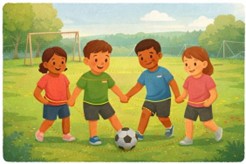
Rope Football is a movement-based team game in which students encounter an unusual form of cooperation. Team members hold onto the same rope and, while being physically connected, try to move a ball towards a designated target area. The uniqueness of the game lies in the fact that familiar football movements cannot be applied automatically, which naturally encourages students to explore the new situation. The primary goal of the game is not winning, but rather to enable students to observe with curiosity how their movements influence one another during joint action, to experience a sense of wonder at the challenges…
-
Old Blind Granny
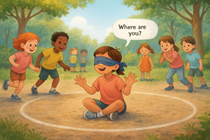
In Old Blind Granny, one child (the “Granny”) is blindfolded and placed in the middle of the play area, while the others move around freely. The blindfolded player must rely on listening, imagination, and curiosity to explore where the others are. Players can make soft sounds, giggles, or taps to guide the Granny, and respond to her call of “Where are you?” with “Here I am!” The goal is not only to find and recognize others, but also to enjoy the wonder of moving and playing without sight, opening space for creative and curious discovery. Skill focus Primary Skill Focus…
-
Tic-Tac-Toe
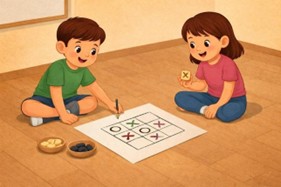
Tic-Tac-Toe is a well-known logic game through which students develop curiosity about possibilities, ask questions, and openly explore how a situation changes as a result of different decisions. The goal of the game is not quick victory, but rather to encourage students to observe with curiosity what happens after each move, recognise connections and patterns, and accept that the same situation can unfold in different ways. During the game, the experience of wonder naturally emerges (for example: “I didn’t expect it to end like this!”), as well as openness, when students are willing to try new strategies or learn from…