
Contents
- 1 Brief description, and rules of the implementation of the learning activity
- 2 Indoor/Outdoor Classroom layout notes
- 3 How does this learning activity develop the primary skill?
- 4 What do we want to achieve regarding primary skill development (student understanding and/or behaviour)?
- 5 Suggested use, and practical examples
- 6 Materials and tools needed for implementation
- 7 Guiding questions
- 8 Tips and Tricks for dealing with challenges
- 9 Difficulty level tailoring
- 10 Debriefing and Reflection questions
-
Brief description, and rules of the implementation of the learning activity
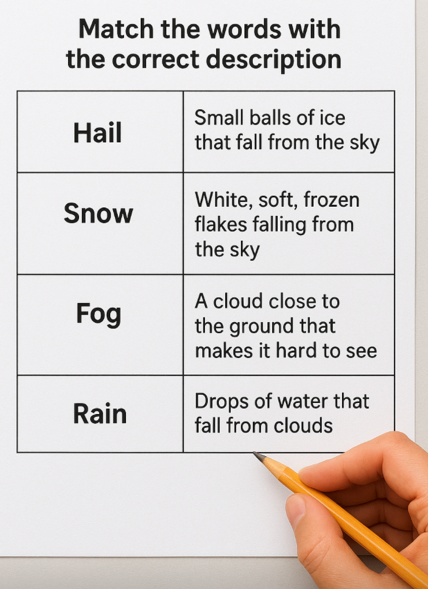
After a theory explanation, the students receive a worksheet. In the left column, there are various terms, and in the right column, the explanations of these terms. The explanations are not in the correct order (or next to the correct term).
Skill focus
Primary Skill Focus
- Critical thinking
Complementary/Secondary Skill Focus
- Problem-solving
Age group Student number Duration 6 -10 years old Individual and whole class working in pairs or small groups 15-20 minutes Proposed step by step implementation of the learning activity
How does it work:
The goal is for students to find the correct combination.
-
Indoor/Outdoor Classroom layout notes
Indoors: ensure that the (class-)room is quiet enough to allow focus and thoughtful discussion and explanations during research. The children also need to be able to write, so it is best if they sit at a desk.
-
How does this learning activity develop the primary skill?
- Analysing information: Students carefully read the descriptions and break down the meaning, which develops their ability to examine information in detail.
- Comparing and contrasting: By comparing different descriptions, students learn to identify similarities and differences, a key step in evaluating options critically.
- Making reasoned decisions: Students make deliberate choices based on evidence and reasoning rather than guessing, which strengthens judgment and reflective thinking.
- Evaluating alternatives: They consider why some descriptions do not fit, which trains them to question assumptions and think logically about cause and effect.
-
What do we want to achieve regarding primary skill development (student understanding and/or behaviour)?
Critical thinking: Students are able to critically evaluate descriptions, make informed matches, and clearly explain their reasoning.
-
Suggested use, and practical examples
Ideally, you also include one extra term without a description. Because there is one description missing, the students really have to think about which one does not fit and eliminate it.
Key tip: Choose terms that belong to the same general theme, but still contain enough variety and doubt, so that students must think about why something does or does not fit into a category – this triggers critical thinking.
-
Materials and tools needed for implementation
The worksheet
-
Guiding questions
Teacher’s role: the teacher is coaching, inquisitive and supportive, encouraging thinking, explaining and rethinking
- Let students explain their choices (e.g., “Why do you think these belong together?”) encourages argumentation
- Exploring alternatives (e.g., “Could you have hesitated between two concepts?”) discussing doubts and alternatives
- Reflecting on how they arrived at their answer (e.g., “How did you decide?”) encourages reflection on their choices
- Questioning descriptions (e.g., “What makes you think this description doesn’t fit?”) promotes critical evaluation.
-
Tips and Tricks for dealing with challenges
- Challenge: Students may struggle to clearly explain why they matched certain terms with specific definitions.
Tip: Encourage students to verbalise their thinking and justify each choice using simple reasoning sentences. - Challenge: Students may match terms and definitions impulsively without reading carefully.
Tip: Ask guiding questions that prompt them to reflect before choosing, such as “What keywords help you here?” or “Does this explanation really fit the term?” - Challenge: Students may find it difficult to correct or reconsider incorrect matches once made.
Tip: Allow time for review and adjustment, encouraging them to re-check and compare alternatives instead of sticking with their first answer. - Challenge: Students may feel overwhelmed by multiple terms and explanations at once.
Tip: Break the task into smaller steps, for example by first eliminating clearly incorrect matches or working with a few terms at a time. - Challenge: Students may rely too much on peers without engaging in their own thinking.
Tip: Organise students in pairs or small groups where everyone must explain at least one match. - Challenge: Students may see mistakes as failure instead of part of the learning process.
Tip: Emphasise that errors are valuable opportunities to learn and improve understanding.
- Challenge: Students may struggle to clearly explain why they matched certain terms with specific definitions.
-
Difficulty level tailoring
When using Smart Match, as a working form with students aged 6 to 10, the teachers can easily differentiate at three levels: beginner, advanced and expert.
- Beginner learners (6-7 years old): Fewer terms and descriptions, with clearer hints or examples. Focus on one criterion per match (e.g., recognizing a single definition).
- Advanced learners (8-9 years old): More terms and descriptions, some overlapping or slightly confusing. Must identify connections independently and justify their choices. Extension: discuss in small groups and provide reasoning.
- Expert learners (9–10 years old): Complex or abstract descriptions with multiple possible interpretations. Must critically evaluate alternatives and support their decisions. Extra challenge: create new matches or counterexamples.
-
Debriefing and Reflection questions
- How did you decide which match was correct? What reasoning did you use?
- Were there any options that seemed correct at first but didn’t fit? Why?
- What alternative solutions did you consider, and why did you reject them?
- How did your thinking change after reviewing or discussing the matches?
- What strategies helped you evaluate information more carefully