
Contents
- 1 STEAM Event Summary
- 2 Real-world STEAM Connection and Problem definition
- 3 Materials at a Glance
- 4 Indoor/Outdoor and Classroom layout
- 5 Notes on Research-based approach and integration
- 6 Lesson Flow Overview (linked to details below)
- 7 Tips and Tricks for dealing with challenges (for the whole STEAM program)
- 8 Difficulty level tailoring notes
- 9 STEAM Program Debriefing and Reflection Questions
- 10 Appendix – Activating the senses – Activity in a nearby meadow or park
-
STEAM Event Summary
Children often spend their daily lives in artificial environments—frequently in urban settings—surrounded by limited material and natural stimuli. For them, it is especially important to connect with nature through direct, personal experiences. Even for those who live closer to nature, it is valuable to reflect on and organize their spontaneous experiences for deeper understanding.
The conscious use of the senses is the foundation of learning. Observation, measurement, and experimentation all build on this. At this age, children typically view the world from an egocentric perspective, but such activities help them realize that others may see the same thing differently. Direct experiences with nature and building connections with living things are essential in today’s world. Only through these can sustainable and environmentally conscious attitudes and mindsets take root.
SPIRIT Skill Focus
This 7-stage STEAM event- while linked to the school curriculum, see in the table – primarily aims to develop the following skills of 6-year-old (first grade) students:
- Empathy
- Creativity
- Curiosity, sense of wonder, and openness
- Valuing people and nature
- Resilience
- Connectedness
- Flexibility
- Emotional awareness, regulation, and communication
Basic Information Sheet
Age group Student number Duration Number of stages Subjects connection and relevance 1st grade students Whole class (max. 30 students) min. 2 x 45 minutes 7 outdoor stages natural sciences, visual arts, physical education, music, native language (vocabulary expansion, mathematics This playful STEAM event, which consists of seven stages linked to nature pedagogy. In the program, the class goes on an excursion to a nearby park or meadow, where they make observations in nature. During their observations, they focus on using one sense more actively at a time. The session also includes other playful activities to make the program more colourful, allowing students to make further meaningful observations and thus connect more closely to nature. Share a personal story or memory related to that emotion.
National curriculum Link and Objectives
- Learning about the senses and organizing perceivable properties
- Creating artworks from natural materials
- Rhythm games
- Exploring movement-based games
-
Real-world STEAM Connection and Problem definition
Average urban children have little or no connection with nature in their everyday lives, living in a built environment far from the natural world. The children spend their daily lives in artificial environments -frequently in urban settings – surrounded by limited natural stimuli. This has a negative impact on their well-being, in the medium term. For them, it is especially important to connect with nature through direct personal experiences. Even for those who live closer to nature, it is valuable to reflect on and organize their spontaneous experiences for deeper understanding. Through discovering and learning about nature
Through being in nature and exploring and learning about nature, they experience that the conscious use of their senses is the basis for learning. Observation, measurement, and experimentation all build on this, which can both stimulate and satisfy their curiosity. At this age, children typically view the world from an egocentric perspective, but such activities help them realize that others may see the same thing differently. This shift in perspective helps develop flexibility, resilience, valuing the nature and people – the key competencies for the future.
Direct experiences with nature and building connections with living things are essential in today’s world. Only through these can sustainable and environmentally conscious attitudes and mindsets take root. During the event, they will experience the importance of nature and its impact on their well-being, the lack of which is a fundamental problem for the current generation.
-
Materials at a Glance
In a small backpack:
- 1 water bottle (filled with water or tea)
- Raincoat (even if the weather doesn’t call for it—it can be used to sit on and will be part of the activities)
- Tissues
- (Any necessary documents or tickets)
-
Indoor/Outdoor and Classroom layout
These activities are designed for outdoor settings, with the layout determined by the specific location(s). Therefore, it is recommended that the teacher visit the site(s) in advance to conduct a walkthrough. This allows them to adapt the tasks—or their sequence—to the local characteristics of the environment.
-
Notes on Research-based approach and integration
During the activity, children are encouraged to observe nature independently – its sounds, colours, and scents. They carry out collecting tasks in the natural environment, where they can explore the diversity of living organisms. This collection is done in groups (or individually), and each group is likely to discover different things. A key part of the activity is sharing these discoveries with one another and learning from each other.
-
Lesson Flow Overview (linked to details below)
-
STAGE 1 – Going to the park
Duration: This depends on the possibilities of the given community (10 to 30 minutes).
Primary SPIRIT Skill(s) focus:
- Flexibility
Brief description
The activities can already be done during the travel. During the journey, children could have tasks.
If travelling on foot:
- Say when you see something that starts with the letter R.
- Word chain (with possible restrictions, e.g., only animals, only names)
- Which traffic signs do you know? Do you see any that you don’t understand?
If using public transport:
- Count how many stops the vehicle has. Is there a stop named after a famous person? Does anyone know who they are? (It’s helpful if the teacher prepares in advance.)
- “How many fingers am I holding, and how many not?” game
If possible, the program can be combined with a hike, during which stops can be made and tasks assigned to the students. For example:
- During a rest break, observe 1 minute of silence. During this time, listen carefully and list the sounds you hear. Were any of the sounds coming from the built environment?
- During the break, observe how many different shades of a single colour you can see, for example, green. First, everyone quietly collects observations, then together, by pointing and naming, identify the different shades.
- During the hike, count the trail markers (touch them if possible). With older students, you can also ask them to estimate beforehand how many markers they will see on a given section of the trail.
- During the hike, count how many birds you hear rustling in the leaves or singing in the trees. (Extra task: try to identify the species.)
How does this develop particular SPIRIT skills
During the journey, a specific task must be carried out in a changing environment (because the bus is moving or we are walking), so the children need to be flexible and continuously interpret and solve the task within the ever-changing surroundings.
What do we want to achieve regarding SPIRIT skill development (student understanding and/or behaviour)?
Children should be able to focus on the same task even in a changing environment and be able to return to it after briefly drifting away.
- Academic/Curriculum Objective connection:
- Teaching traffic knowledge
- Developing counting and estimation skills
- Improving observation skills
- Expanding vocabulary and vocabulary usage
- Spatial orientation
Materials and tools needed for implementation
None
Preparation notes
The teacher must be familiar with the route, the timing, and the possibilities.
Guided Questions
- How can you quickly switch between tasks when the environment changes?
- How does it feel when you see or hear something unexpected? How can you adapt to it?
- Can you pay attention to your surroundings and the game at the same time? How do you do that?
- If your mind wanders away from the task for a moment, how do you get back to it?
- What happens if you don’t recognize a traffic sign? How can you find out what it means?
Stage Debriefing Questions (Optional)
- How did you feel during the journey?
- How did you spend your time?
- Which part of the trip did you like the most?
Tips and Tricks for dealing with stage challenges
- Games and activities should be offered to the children, but participation is not mandatory. However, these activities can lay the foundation for later tasks, engage the children’s thinking, entertain them during the journey, and help prevent misbehaviour. Therefore, the teacher should observe which children need to take part in the suggested activities.
- Some activities are done together (for example, one minute of silence during a break), and in these cases, everyone participates at least by not disturbing others’ work.
-
STAGE 2 – Observing the weather
Duration: 10 – 15 minutes
Primary SPIRIT Skill(s) focus:
- Flexibility
- Valuing people and nature
Brief description
Upon arriving at the location, the children sit down in a pile (on their raincoats).
- Close your eyes! What do you feel? What is the weather like now? (Temperature, sunshine, wind, freshness of the air)
- How did you know what the weather was like with your eyes closed? How (with what) did you sense it?
- It is currently ___ °C. Who feels cold? Who doesn’t feel cold?
- How is it possible that we felt differently even though we are in the same place and the temperature is the same? What does this depend on?
- Can people perceive different things? Can people feel differently?
- How do we actually know what the temperature is? Does it depend on who observes it?
We can measure and observe certain properties of the things around us.
How does this develop particular SPIRIT skills?
Resilience fundamentally requires understanding how our own perceptions work and how they relate to reality. This way, we will be able to determine how to interpret the effects that impact us.
What do we want to achieve regarding SPIRIT skill development (student understanding and/or behaviour)?
Students experience the subjective and objective interpretation of things. They should realize that what they perceive subjectively can also be viewed objectively, and this objective perspective reinterprets our subjective perception without questioning the reality of that subjective experience.
Academic/Curriculum Objective connection
- Observation and conscious use of the senses
- Measuring temperature
- Observing elements of the weather
- Developing debate skills
Materials and tools needed for implementation
None
Preparation notes
Not necessary
Guided Questions
- How do you react when the weather or environment suddenly changes, and you need to refocus?
- What can you do if others perceive the same situation differently, and your opinions don’t match because of that?
- How can you calm yourself down or concentrate when your perceptions are confusing or conflicting?
- In what ways can you use others’ observations to reassess your own?
Stage Debriefing Questions (Optional)
- Was there a moment when you experienced something different from what you expected? How did you handle it?
- Were you able to change your opinion after one of your observations? What helped you do that?
- What was difficult about this task, and how were you able to overcome it?
- Was there a situation when you thought differently from the others? How did that make you feel?
- How did it feel when you had to reinterpret something you had originally thought differently about?
Tips and Tricks for dealing with stage challenges
- Children at this age tend to interpret the world very subjectively. They may have difficulty accepting their peers’ opinions. In such cases, gently guide them, as they still need time to be able to accept different viewpoints. However, they can only develop this ability if they encounter perspectives different from their own, so it’s okay to provoke these situations.
- Pay attention to when to close a possibly arising debate, even if they haven’t reached an agreement. For example: “I understand what you’re saying, but we can’t agree on this right now. We can talk about it later, and everyone can think about it until then… Now let’s move on, because there are still interesting things to discover.
-
STAGE 3 – Run, touch and find!
Duration: 5 – 10 minutes
Primary SPIRIT Skill(s) focus:
- Flexibility
- Valuing people and nature
Brief description
In this stage, we make the children move. The task is to find something in nature that has a feature that the teacher “suddenly” asks for. The children do not know in advance what the teacher will ask for. Children should find different materials in nature by touching.
Stand up! Run and touch something that is…”
- made of wood!
- made of metal!
- rough to the touch!
- soft to the touch!
- wet!
- dry!
- cool!
- warm!
How does this develop particular SPIRIT skills
While touching different materials, children continuously perceive various textures, which stimulate their sensory nerves. These nerves must constantly adapt, providing a physiological foundation for both cognitive and emotional flexibility. In addition, children must quickly and spontaneously respond to unexpected instructions by finding and touching an item that fits the given description as fast as possible
What do we want to achieve regarding SPIRIT skill development (student understanding and/or behaviour)?
During the activity, children develop sensory awareness as they recognize different materials and temperature qualities while moving. The quickly changing instructions promote cognitive and emotional flexibility, as they need to adapt to new situations and stay focused on the task. This supports their self-confidence and flexible attitude toward situations, while also strengthening their social skills.
Academic/Curriculum Objective connection
Recognition of different materials and experiencing their properties.
Materials and tools needed for implementation
None need materials. Things in their environment
Preparation notes
The teacher should be familiar with the location in order to give varied and engaging instructions.
Guided Questions
- How can you react quickly when you receive an unexpected instruction?
- How do you feel when you suddenly have to change what you are doing?
- How do you quickly find the material you need to look for based on the instruction?
- What helps you keep your focus when you have to touch different materials one after another?
- How can you stay calm when the instructions change quickly?
Stage Debriefing Questions (Optional)
- Was there a moment when it was difficult to switch quickly between tasks? How did you handle it?
- What did it feel like when you had to unexpectedly change your activity?
- Were you able to help others if they reacted more slowly to the instructions?
- What helped you stay calm when you had to touch different materials one after another?
- How could you handle unexpected changes even better next time?
Tips and Tricks for dealing with stage challenges
In this stage, the same issues may arise as were described in the previous stage. In this case the guidelines described there also apply.
-
STAGE 4 – Rhythm game
Duration: 10 minutes
SPIRIT Skills:
- Curiosity, sense of wonder, and openness
- Creativity
- Valuing people and nature
Brief Description:
The children look for natural objects they can use to “make music” with. Examples include snapping dry sticks, rustling dry leaves, blowing on grass, clinking stones, hitting sticks together, or tapping sticks on the ground. The children search on their own, but the teacher can also offer suggestions.
The children are divided into three groups. The teacher demonstrates the rhythm each group should follow:
- Group 1: TA-TA-TA-TA
- Group 2: TI-TI-TA-TI-TI-TA
- Group 3: TI-TI-TI-TI-TI-TI-TI-TI
First, each group practices separately. Then the teacher gradually adds groups one by one until all three groups play together. Once they manage this, the groups switch rhythms. If background noises are heard (e.g., a singing bird or construction sounds), incorporate those rhythms into the activity as well.
How does this develop particular SPIRIT skills
During the activity, the children need to be able to partially separate the rhythms of the other groups in order to focus on their own. This is the first step in developing resilience: learning to filter out and exclude the influences and stimuli that frustrate or hinder them. At the same time, more experienced children are not only able to distance themselves from the rhythms of others but can also perceive them simultaneously. This allows them to have a more complex musical experience. This represents a higher level of resilience, where although I can separate stimuli and feelings, I am still able to pay attention to them, interpret them, and incorporate them into my own experiences.
What do we want to achieve regarding SPIRIT skill development (student understanding and/or behaviour)?
The rhythm activity aims to develop children’s ability to focus their attention, particularly in filtering out distracting stimuli, which enhances their flexibility and adaptability.
During the activity, students learn how to separate their own rhythm from environmental noises, strengthening their self-control and emotional stability—key components of resilience. Additionally, the activity helps them to perceive and integrate multiple stimuli simultaneously, fostering more complex and conscious processing skills that contribute to the development of their problem-solving and adaptive abilities.
Academic/Curriculum Objective connection
- Following the rhythm
- Maintaining the rhythm
- Experiencing the properties of materials (hardness, flexibility, etc.)
- Identifying given materials by their sound
Materials and tools needed for implementation
Natural materials found in their environment. Artificial materials can also be included if necessary.
Preparation notes
The activity is conducted in a location where a variety of materials can be found (e.g., riverbank – stones, trees, seeds, empty snail shells, etc.)
Guided Questions
- How can you pay attention to your own rhythm while others are playing around you?
- What happens if another group’s rhythm is different from yours? How can you still concentrate?
- How do you react when you have to quickly switch to a different rhythm?
- What can you do if your attention drifts because of the other groups’ rhythms?
Stage Debriefing Questions (Optional)
- Was there a moment when it was hard to focus on your own rhythm? How did you handle it?
- How did it feel when you had to adapt to another group’s rhythm?
- What was the most difficult part of the activity, and how did you overcome it?
- What did you learn about staying calm and focused when there is a lot of noise around you?
Tips and Tricks for dealing with stage challenges
When dealing with challenges during rhythm activity, it is important to encourage children to focus on their own rhythm while staying open to the sounds of others, which helps them adapt to changes more easily.
- If a child has difficulty concentrating amid the surrounding noise, help them take deep breaths and slowly refocus on their own rhythm. Introducing new rhythms gradually allows children to better follow the transitions. Start with simple, easy-to-remember rhythms and gradually increase the difficulty to develop their attention and adaptability.
- If someone gets distracted, encourage them to observe the rhythms of others and then try to rejoin their own group. Creating a calm and friendly atmosphere where making mistakes is not a problem helps children feel more confident to try new things.
-
STAGE 5 – Art from Natural Materials
Duration: 20 + 10 minutes
Primary SPIRIT Skill(s) focus:
- Creativity
- Valuing people and nature
- Curiosity, sense of wonder and openness
Brief Description:
The children create a picture using natural materials found in the area (nothing should be picked up or torn). It is best to work in teams (you can divide the previous task’s groups further). The children have 20 minutes to work, after which everyone walks around to look at each other’s creations.
The composition can be made freely, but a common theme can also be given to guide the artwork, such as nest, human figure, or ant playground.How does this develop particular SPIRIT skills?
In this activity, children are encouraged to view and use natural materials in new and unfamiliar ways. They need to rely on their imagination to discover the potential in different objects and to find creative uses for them.
The task also requires teamwork, which involves listening to and understanding each other’s ideas, and connecting to them with flexibility. It’s important for the children to accept if the final result doesn’t fully reflect their own initial vision. This kind of acceptance may happen smoothly, but it can also involve small conflicts – working through these challenges contributes to the development of resilience.
What do we want to achieve regarding SPIRIT skill development (student understanding and/or behaviour)?
The goal of the activity is for children to learn how to use natural materials creatively and in ways that differ from their usual experiences, using their imagination to assign new meaning to familiar objects. This fosters the development of imagination, openness to new types of thinking, and the ability to reinterpret existing elements flexibly. Through working together, they practice how to adapt to others’ ideas, collaborate with peers who may have different perspectives, and accept when the process or outcome does not fully match their own expectations. All of this helps them build patience, flexibility, and a problem-solving attitude during cooperative creative work.
Academic/Curriculum Objective connection
- Visual creation using natural materials
- Observing the shapes and forms of natural materials
- Shaping and manipulating natural materials
Materials and tools needed for implementation
Natural materials found in their environment.
Preparation notes
The activity should be carried out in a location where a variety of materials can be found, for example, at the borders of different habitats – where a forest, a field, and a riverside meet.
Guided Questions
- How were you able to accept it when the picture turned out based on someone else’s idea, not the way you wanted?
- What was the reason that made you look for a new solution during the group work?
- How did you manage to solve it together when someone wanted something different to appear in the picture?
- How did it feel when your idea changed during the work?
Stage Debriefing Questions (Optional)
The children present their works to each other, and related questions can be asked either by the children themselves or formulated by the teacher.
- Was there a moment when it was difficult to accept others’ ideas? How did you solve it?
- What did you learn about working together with people who think differently?
- How did it feel when you had to be flexible during the group work?
- How can you apply what you learned now even better next time in group work?
Tips and Tricks for dealing with stage challenges
The duration of the activity can vary, so the teacher should adjust it according to the situation.
- If there is a big difference between groups, those who finish earlier can continue working on their creation or make additional pictures. It is important for the teacher to move continuously between groups, monitor the work, and provide help if needed.
- Challenges may include preserving the integrity of materials, encouraging creativity, managing disagreements during group work, properly managing time, and handling external environmental distractions.
-
STAGE 6 – Living Camera
Duration: 20-30 minutes
Primary SPIRIT Skill(s) focus:
- Creativity
- Valuing people and nature
- Curiosity, sense of wonder, and openness
- Empathy
Brief Description:
The children pair up. One will be the “camera”, and the other will be the photographer. The “camera” must keep their eyes closed. The photographer can position the camera by gently guiding their partner to the spot where they want to take a picture. The photo is taken as follows: the photographer lightly taps the camera’s right shoulder, and the camera can open their eyes until the photographer taps again, signalling to close their eyes once more.
Draw the children’s attention to the following points:
- The “shutter speed – exposition time” (the time between the two shoulder taps) can be short or long. It shouldn’t be too short, or the photo won’t be well and rich in details enough.
- Zooming is possible — if the camera is guided close to something, it takes a close-up picture; if positioned farther away, more will be included in the picture.
- The camera can be carefully kneeled down, or their head moved gently.
- The photographer should plan in advance what should be in the picture.
- 3 to 4 pictures should be taken by a photographer, and make sure they are varied!
After the photographer finishes, they switch roles.
If possible, the children can draw their favourite pictures on-site (bring drawing boards, paper, and pencil cases), or back in the classroom, they can “make” the photos. (It’s useful to first recall the pictures with eyes closed in a “darkroom” setting.) Please decorate the classroom with the pictures.
How does this develop particular SPIRIT skills?
During the activity, the children will suddenly face a visual scene completely vulnerable with their eyes closed. They do not have control over the situation and must quickly take in the view. Beyond the feeling of uncertainty, the learner always experiences a positive moment, ensured by their partner. An important component of resilience is the ability to trust others who help and look out for you, knowing you can turn to them and that you are not alone.
From another perspective (the photographer’s point of view), they must interpret things from their partner’s viewpoint. For example, I can step over a branch because I see it, but my partner cannot because they do not see it; I am still far from the tree, but my partner is already close; I see something, so how can I show it to them, so they see the same? These aspects develop flexibility.
What do we want to achieve regarding SPIRIT skill development (student understanding and/or behaviour)?
The goal of the activity is to help children develop their resilience and flexibility by learning to trust their peers, accept uncertainty, and quickly adapt to unexpected situations. This supports their ability to function effectively both independently and in groups, respond flexibly to changing circumstances, and become emotionally more stable in school life and everyday situations.
Academic/Curriculum Objective connection
- Learning principles of composition
- Shifting perspectives
- Trust-building exercises
Materials and tools needed for implementation
- If time allows, use a drawing board, paper, and coloured pencils (or crayons).
- If creating on-site is not possible, the images can also be “developed” later in the classroom.
Preparation notes
It is recommended to conduct the activity in an open area where there is the opportunity to see both near and far, such as a clearing or a hilltop.
Guided Questions
- What do you need to pay attention to when guiding your partner to keep them safe?
- How can you make sure they see what you think is important?
- What can help you feel safe even when your eyes are closed?
- How do you decide where to take the next picture from?
Stage Debriefing Questions (Optional)
- How did it feel when you weren’t the one in control, but just followed someone else?
- Was there a moment when things didn’t go the way you wanted? What did you do then?
- What was the best part of having someone else show you the world?
- What did you learn from having to pay attention to your partner—and them paying attention to you?
- Did the thought of playing a trick cross your mind? Why didn’t you do it? (If there is concern about safety during the activity, these types of questions and rules can also be discussed beforehand).
Tips and Tricks for dealing with stage challenges
- It is difficult to determine a fixed duration for this activity, as sometimes children finish quickly, while other times they become deeply engaged in the task. The teacher should decide on the ideal duration based on the current situation.
- After explaining the task (5 minutes), it is still recommended to dedicate at least 15 minutes to the activity, even if everyone finishes quickly. In such cases, the group can be brought together to give advice on not rushing and offer tips on how to become more immersed in the task. A minimum of 15 minutes is necessary for meaningful engagement: finding a location and subject, carefully guiding the partner, and switching roles.
- If there are big differences between the pace of pairs, those who finish early can take more photos. The teacher should closely observe the students’ work and give advice when needed to ensure truly meaningful and well-thought-out pictures are taken.
-
STAGE 7 – Take Cover! (Closing Game)
Duration: 20-30 minutes
Primary SPIRIT Skill(s) focus:
- Flexibility
- Problem-solving
Brief Description:
In this closing activity, one child is chosen (to be a “HUNYÓ” – a seeker). She/he stands in the middle of the play area with closed eyes, extends her/his arms sideways at shoulder height, shouts “TAKE COVER!”, and counts down from 19. During this time, the other players must quickly run up, touch the HUNYÓ’s hand (while saying their own name), and then hide somewhere in the play area.
When the HUNYÓ finishes counting, opens her/his eyes and tries to spot the players without leaving their spot. They can move slightly, but one foot must remain in place at all times. If the HUNYÓ sees someone, calls out the player’s name, and that person must come out of hiding.
If the HUNYÓ no longer sees anyone, they close her/his eyes again, extends her/his arms, shout “TAKE COVER!” once more, and count down again—but this time starting only from 17. With each new round, the countdown begins from a number 2 less than the previous round, giving players less and less time to hide. This increases the challenge and encourages players to hide closer to the seeker. A key rule is that players cannot hide in the same spot twice in a row. Game variation: To make the game more dynamic, the HUNYÓ may take up to three steps while searching the players. If they still don’t see anyone after the third step, they shout “TAKE COVER!” again from their new position. This keeps the hiding spots changing and adds excitement to the game.
How does this develop particular SPIRIT skills?
The game supports the development of flexibility as students must quickly make decisions about new hiding places and adapt to constantly changing situations. Resilience is strengthened as children learn to cope with setbacks (e.g., being found early) and try again. Within a safe and joyful environment, the game helps build perseverance, self-regulation, and attention to others.
What do we want to achieve regarding SPIRIT skill development (student understanding and/or behaviour)?
The goal of the game is for students to develop the ability to quickly adapt to changing situations and respond flexibly to new challenges. Strengthening resilience is important, meaning learning to manage setbacks and develop a persistent, restarting attitude. Additionally, the game helps improve attention, self-regulation, and the ability to be considerate of peers.
Academic/Curriculum Objective connection
- Outdoor movement game
- Counting backward one by one
- Number sequences decreasing by twos.
Materials and tools needed for implementation
None
Preparation notes
Choose an area with plenty of hiding spots, such as bushes, shrubs, trees, small hills, etc.
Guided Questions
- How did you handle it when you couldn’t find your hiding spot right away?
- What did you do when you had to hide quickly and had little time?
- How did you feel when someone else was chosen as the seeker?
- What did you do when the game didn’t go the way you expected?
Stage Debriefing Questions (Optional)
- What helped you adapt quickly when the rules or situations changed?
- How did you feel when you had to start the game over again and again?
- What did you learn about playing with others who think or act differently?
- How can you use what you learned in this game in other situations, like at school or at home?
Tips and Tricks for dealing with stage challenges
- The main purpose of the game is to release the tension built up during the many activities, so it is definitely worth ending the session with this or another active game. The children have done serious mental and emotional work. Of course, skills are also developed during the game, but the focus here is not on that; rather, it is about closing the entire program with a positive, light-hearted experience.
- Common issues in children’s play:
- The seeker does not shout loud enough.
- The seeker should start counting from an odd number each round, which is 2 less than the starting number in the previous round. Children often get this wrong. It’s not very important, but it’s good to pay attention to it because it helps develop skills.
- They clap too hard on the seeker’s palm. Remind them if it feels uncomfortable for the seeker
-
-
Tips and Tricks for dealing with challenges (for the whole STEAM program)
- The time frame can vary significantly between groups. This is partly because first graders have different levels of endurance, and partly because some groups may become more deeply engaged in certain activities. In the first case, it’s perfectly fine to split the sessions into multiple parts and go outside more frequently or plan the program from the start with longer breaks between activities (free play, meals, changing locations, etc.).
- If the children want to immerse themselves more deeply in a particular activity, we should allow them enough time and definitely avoid rushing them.
- Ideally, these sessions can be part of a whole-morning or even full-day program, such as a field trip. Reflection and summarizing can take place on site, but feedback can also be postponed to the following day in the classroom setting, where there is an opportunity for discussion and drawing the experiences or “photos.”
-
Difficulty level tailoring notes
If there is an opportunity to spend more time in nature, the activity can be expanded with additional tasks.
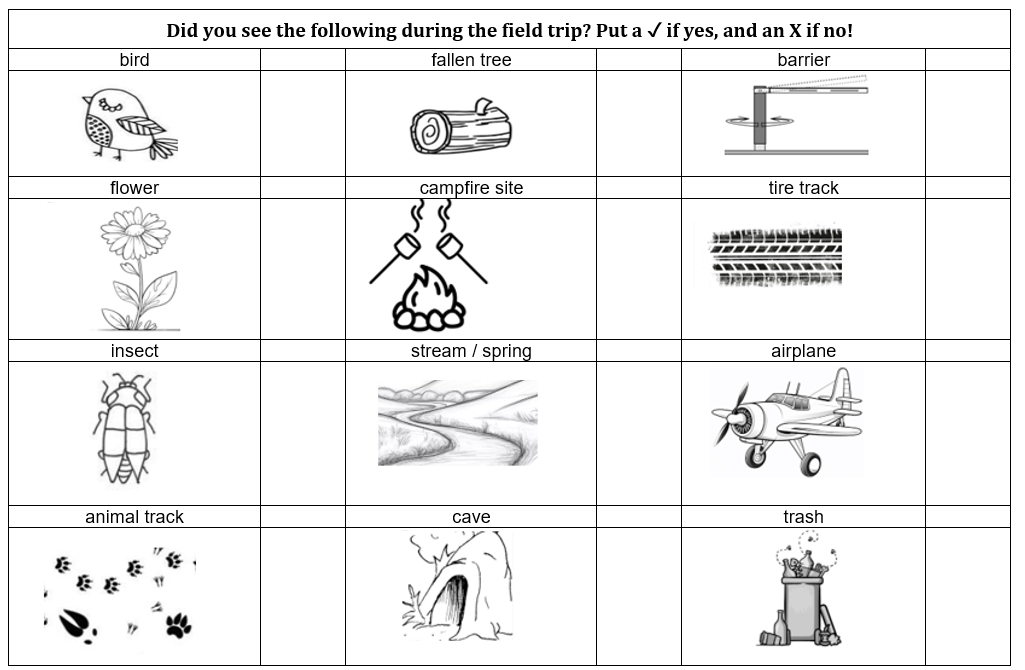
- Checklist
The children receive a sheet with pictures (pictograms) of various items. They mark on the sheet what they have seen and what they haven’t.
Recommended checklist:
2. Taste and Smell
Experiencing this is more difficult, but here are a few ideas that should be tried with proper expertise:
- Drinkable spring water
- Tasting well-identified (medicinal) plants (e.g., lemon balm, wild garlic – not lily of the valley! –, nettle [after being folded])
- The scent of forest soil
- The smell of leaves (by rubbing them)
- Identifying scents carried by the wind (e.g., smoke, a nearby animal farm, exhaust fumes from vehicles on a nearby road, etc.)
-
STEAM Program Debriefing and Reflection Questions
- Did you recognize an emotion that you hadn’t thought about much before?
- Which emotions do you think are the hardest to talk about?
- How do you usually express emotions like anger or sadness? Do you think that’s helpful?
- How can we better recognize emotions in others and support them when they feel that way?
- How did you feel hearing your classmates talk about these emotions?
- Which emotions are easiest or hardest for you to talk about?
- What can we do to help someone who is feeling this emotion?
Based on the experiences gained, knowledge related to the senses can later be made conscious and organized in the classroom.
The main focus of the day was engaging the senses, so the follow-up questions should also relate to these. For example:- Which of your senses did you have to use during the trip? Which ones were used in which activity and how?
- How do we use each sense? We see, hear, touch, smell (taste).
- What kinds of perception do we have? Hearing, sight, touch, smell (taste).
- Which of your senses did you use the most?
- Which one did you use the least?
- Was there a sense you had to use more intentionally today, or one you paid more attention to while using it?
You can also ask questions related to the nature walk itself:
- What living things did you encounter? (Encourage children to think not only of animals but also of plants and fungi!)
- What kinds of habitats did we visit?
In terms of competence development, you might also ask:
- Was there a moment today when you had to try something again? What helped you not give up? (To support perseverance and intrinsic motivation.)
- What was the biggest surprise for you today? How did you react? (To reflect on adaptation to unexpected situations.)
- Was there a time when you had to cooperate with others to solve something? How did you manage it? (To develop social skills and collaborative problem-solving.)
- Was there something you didn’t understand at first but figured out later? What helped you understand it? (To strengthen the awareness of learning and personal growth.)
-
Appendix – Activating the senses – Activity in a nearby meadow or park
-
Pilot implementation (detailed example with lesson/activity plan) – attachments – Activating the senses – Activity in a nearby meadow or park
-