
Introduction
The evolution of modern games has led, albeit not immediately, to a reflection on the pedagogical benefits of playing. Thousands of new games are developed every year, most of them available in all partner countries. This creates a huge variety and a huge number of opportunities for teachers.
A wide variety of games means a wide variety of ways of thinking, a great diversity of activities, a large choice of topics, the possibility to play alone or with lots of people, to play for 3-4 minutes or 3-4 hours, with one and a half year olds and with adults.
Whatever you are looking for, you will find it. For example, if we are looking for board games that are good for developing different competencies, we will find them, the immersion is so huge. This requires a good pedagogical approach, a great knowledge of games and a great knowledge of the learners. But then there’s nothing else to do but just teach the children to play and let the playing work.
However, to achieve our pedagogical goals (which in this case is the development of transversal skills) the most important criterion is that play should always be play! “We must respect this in all our planning and decisions. No matter how great our pedagogical and skill development goals we have, if the child is not yet at the level of the game, if there are no suitable playmates, if the location is unsuitable, if the participants have other interests, etc. We need to think through all the possibilities, we need to have plans B, C, D and it is almost impossible to achieve a sure success with only 1-2 games.”[1]
The power of play – Lifelong kindergarten approach[2]
The mission of the Resnick’s Lifelong Kindergarten research group is „to extend the kindergarten approach to learners of all ages (including the elementary school students too). To do that, we are cultivate caring community that, in the spirit of kindergarten, engage young people in creative learning experiences, so they have opportunities to think creatively, engage empathically, and work collaboratively” The principle of the „kindergarten learning model” is called as 4P’s of creative learning: project, passion, peers and play.
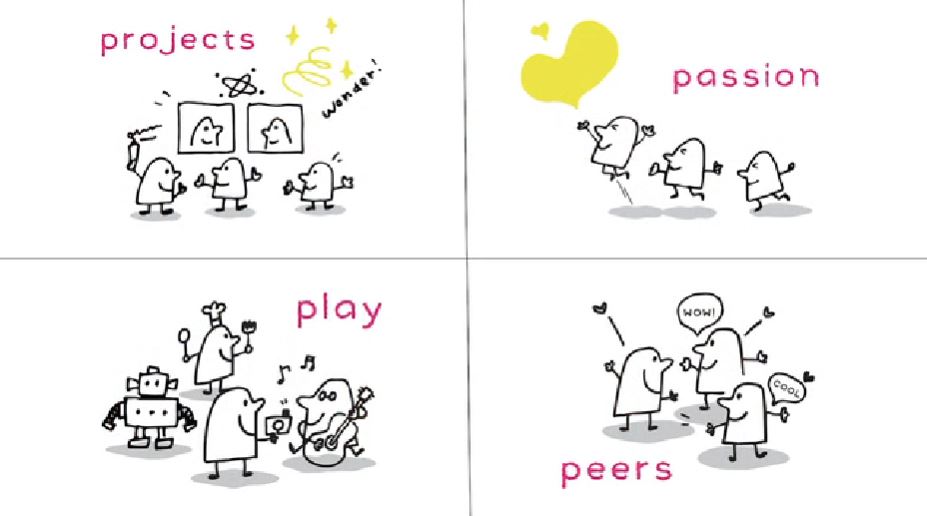
For development of the transversal skills, we will collect and offer a wide range of games (indoor, table outdoor games) that are in line with our pedagogical credo of creating and keeping learning passion for learners, as follows:
- Focus on doing, exploring, experimenting and not teaching/developing directly. Involve as many activities and games into the development journey as possible, and encourages hands-on experiences, tinkering and ensure the active participation for all.
- Let the game always be a game (and make the learning and development game based). It means that enables children to learn and be developed through play
- Focus on children’s interests and organise their development journey around activities and games they enjoy doing (interest driven learning and development). Use, keep and develop the students’ intrinsic motivations and passions as the long-term driving force of their development by allowing them to pursue topics that excite them. Let them choose the games and activities they like.
- Put the children to the “driver’s seat” and allowing them to control their learning experience. Do not tell and control them what and how they must play. Do not show them the suggested tactics in advance, how they can win for sure, but let them discover their own tactics and methods. Let them explore, lose, think, be curious, do and decide on their own and win according to their own ideas. But leading them with opportunities and encouragement. (Don’t show them in advance the suggested winning tactics, how they can win for sure, but let them discover their own tactics and methods. Let them explore, lose, think, be curious, do and decide on their own and win according to their own ideas.)
- Ensure the collaboration, not only the competition. Doing and playing together and in teams. Do the thing together is exciting.
- Creating a playing climate and using tools that ensure open discussion, creative thinking, and learning from mistakes, as well as create a safe environment to meet and deal with failure.
- Use different games and wide variety of activities. The chosen methods have to ensure to connect to real life, community, solve an open-ended issues and challenges, experimenting, discovering, tinkering, etc.
- Support and focus on process, not only the results. Let the games develop open mindset.
- Let the flow feeling for the kids. Keeping the students in a psychological state of deep engagement and concentration that the students can experience when the challenge of a task matches an individual’s skill level, are sufficiently stimulating to capture their interest.
Based on the requirements for games and play, the partnership has adapted and successfully piloted 30 games (mostly well-known in the partner country) that develop the competences of primary school students for future well-being through playing. We invite you to try them out with your students.
How to develop children’s transversal competences with board games[3]
The simplest, shortest and perhaps most surprising answer to this question is “don’t develop them, just let them play”. There are so many developmental elements in every game. Some games focus on very clear areas of development, even some that are strongly linked to a single discipline. We can think here of maths, addition, if we have to add up the scores. But games in general, or more specifically, playing games, develop in a much more comprehensive way. For example, with a very simple game, in addition to playing, we can observe whether we’re risk-aversive, whether we’re able to change our attitudes, because it’s often not good in a game if we’re too safety-oriented, and the question is whether we’re able to change our attitudes in order to win or just to enjoy the game more.
To be able to develop complex skills or skills in a complex way through playing games in a way that is not noticeable and enjoyable for children, but at the same time, as a teacher, we still need to be able to consciously develop complex skills or skills in a complex way, it is essential to find games that develop those areas. And one of the most important requirements for this is to have a great knowledge of games and to be able to select the games that are suitable for the development of the given area.
It is essential that play always remains play for the child! In other words, never let children know that we are playing this game because we want to improve their reading comprehension and we would like them to be a bit more creative. Everything should be about getting the children as motivated as possible. Apart from that, these should be planned, structured, thoughtful and conscious situations for the teacher!
Another very important thing to be able to develop the child’s flow feeling is that children can choose and decide what they want to play with in a given situation. So, when we want to develop some skills area, we should not just have one or two games, but several ones that develop that particular area, so that the child can choose which game they are more interested in, which one suits them or their mood, without knowing the area we want to develop. In other words, in order to develop a given skills, or skills area effectively, we need to know and have 8-10 games for the skills area.
For example, adequate knowledge of games is also important to be able to select games of different difficulty levels, to be able to offer games based on very simple choices, but also to be able to support development by teaching complex games where a number of factors and correct interpretation of information are required over a long period of time and where the route to winning is not the easy one.
Emotions, empathy, resilience and more
Let’s talk a little about some specific SPIRIT transversal skills. To start with, it’s no coincidence that we talk a lot about emotions in relation to games and playing. Especially about whether someone can lose or how they handle situations of stress, temptation of luck, or even success. Almost any board game or game can serve as an example in this domain, as we can experience emotions and learn to manage them in a protected environment, fighting for symbolic goals.
As parents or teachers, one of our most important tasks is to ensure that children can develop through play, joyfully and spontaneously, experiencing their emotions freely and respecting each other. Playing, especially board gaming, as an activity, can be a very good way to support the development of this area.
If we simply consider that good board games are building on trying to make the best possible decisions based on the interpretation of the information available, then there can be no doubt that children’s creativity, problem solving or critical thinking develops whatever we play with them.
Adaptability, reinvention and flexibility are essential aspects of the games. Information is constantly changing, well worked out plans can fall to pieces. Moreover, most good games don’t even give us a complete set of information, so we have to adapt to a lot of uncertainty Games, whether outdoors or in the classroom, played in groups or individually, create “what if” situations, so they are a great way to test ourselves in difficult situations that require flexibility, resilience, structured problem solving, information selection and evaluation, but have no real stakes.
Even ordinary games require a high level of interdependence if you really want to play well. Moreover, group games or board games are themselves a social activity that is much less enjoyable without a high level of empathy. Building a shared culture of playing is also essential in groups of children, and empathy is a key element.
One more thing – final thought
It is strongly recommended that the teacher should, if possible, participate in the game, as he or she can teach and educate a lot through his or her behaviour patterns and reactions to situations.
[1] József Jesztl – Máté Lencse: Boardgame pedagogy 2018.
[2] The idea and the phrase of Lifelong kindergarten was firstly raised by Mitchel Resnick, LEGO Pappert Professor of Learning Research at the MIT Media Lab, Resnick’s Lifelong Kindergarten research group has developed a variety of educational tools that engage people (particularly children) in new types of design activities and creative learning experiences.
[3] An extract from the thought inspiring introduction of Máté Lencse’s presentation about the games for transversal skills development during the 6th Hungarian SPIRIT CoP