
Empathy
Empathy is the ability to understand and share the emotions and viewpoints of others, putting oneself in their shoes both emotionally and cognitively. This skill is at the heart of interpersonal relationships and lays the foundation for creating a more harmonious and cooperative society.
-
Scopa
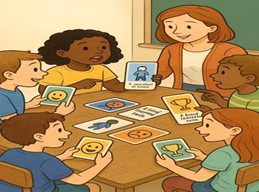
The game is inspired by Scopa, a traditional Italian card game in which players collect cards through matching and strategy. In this adapted version, instead of numerical values, children match cards based on emotions. This maintains the original game’s turn-taking and decision-making dynamics while shifting the focus toward emotional recognition and expression. Skill focus Primary Skill Focus Complementary/Secondary Skill Focus Age group Student number Duration 6-10 years old 2-6 children 20-30 minutes
-
The emotional telephone
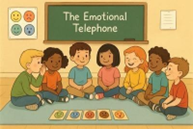
This game follows the classic “whispering telephone” rules, but instead of transmitting a word or phrase, an emotion is conveyed through a short verbal and non-verbal expression. The child receiving the message must interpret it and pass it on to the next participant until the last child, who will try to identify the original emotion. Skill focus Primary Skill Focus Complementary/Secondary Skill Focus Age group Student number Duration 6-10 years old 6-15 children 15-20 minutes
-
The Postman of Emotions
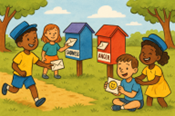
In this adapted version of the postman game, children “deliver” emotional messages to each other. The messages contain emotional situations, and the receiver must guess and react to the emotion, helping the group learn to name, interpret, and empathize with various feelings. The game strengthens empathy and emotional awareness by encouraging children to recognize and express emotions in a non-verbal and creative way. Each child must interpret an emotional situation, imagine how it feels, and translate that inner state into gestures, posture, or tone of voice. This process develops their ability to identify emotions in themselves and others, even when…