
Empathy
Empathy is the ability to understand and share the emotions and viewpoints of others, putting oneself in their shoes both emotionally and cognitively. This skill is at the heart of interpersonal relationships and lays the foundation for creating a more harmonious and cooperative society.
-
Empathy Circle of Stories
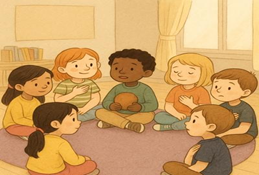
This activity is designed to help children explore emotions through storytelling and practice empathy by listening and responding with care. Children sit in a circle and share real or imagined stories about times they felt certain emotions, while the rest of the group practices listening and responding empathetically. This activity develops empathy through shared storytelling in a respectful listening environment. Children take turns sharing short personal stories related to an emotional prompt, while others listen attentively and then reflect on the feelings involved.
-
Empathy Role-Play Trail (outdoor)
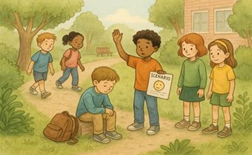
In an outdoor role-play trail, children encounter stations with scenarios where someone needs empathy. They take turns acting out the role of helper, learning how to recognize emotions and offer support. This activity develops empathy by placing children in simulated real-life situations where they are required to recognize emotions and respond in supportive ways. As they walk through the trail and encounter different scenarios, children are encouraged to step into someone else’s shoes — both literally and figuratively.
-
Empathy Think-Pair-Share
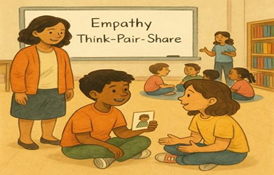
This Think-Pair-Share adaptation focuses on seeing situations from someone else’s perspective, helping children practice stepping outside their own point of view. This variation of Think-Pair-Share centers empathy by asking students to respond to emotionally charged scenarios. First, they think individually about how they or another person might feel, then share with a partner, and finally with the group. This activity works well at different moments of the school day, especially after a story, a conflict, or a collaborative task. It encourages children to reflect not only on their own point of view but also on others.
-
Empathy through Literature
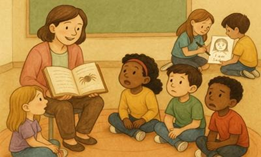
Reading or listening to stories that highlight characters’ emotions provides a rich context for children to practice emotional perspective-taking. This activity encourages children to notice and name how characters feel, why they might feel that way, and what might help them. Using classic children’s books, the teacher leads discussions and activities that explore the emotions, thoughts, and motivations of the characters, helping children step into the characters’ shoes and reflect on how they would feel in similar situations.
-
“Walk in My Shoes” – A Think-Pair-Share Adaptation for Empathy Training

In this empathy-focused adaptation of Think-Pair-Share, children are invited to step into the shoes of others. They first reflect individually on an assigned scenario, then discuss in pairs how they would feel and what they would need if they were in that situation. Finally, they share their partner’s thoughts with the whole class, practising both perspective-taking and listening to understand. In this activity, children encounter brief stories or situations presented as footprints or stepping stones. Each step invites them to imagine how someone else feels and what kind of support or response might help.