
Emotional awareness regulation and communication
For the past 50 years, it has been evident that developing emotional competence is a cornerstone of promoting the well-being of children and adults. Emotional competences are broad and multifaceted, encompassing three key aspects: emotional awareness, emotion regulation, and communication of emotions. Emotional awareness is the ability to recognize and identify one’s own emotions and those of others, involving understanding personal feelings and associating them with specific experiences. Emotion regulation refers to managing emotions appropriately and productively, rather than reacting impulsively, teaching children to calm themselves, express frustration constructively, and deal with intense emotions like anger or sadness positively. Communication of emotions involves expressing feelings clearly and respectfully, verbally and non-verbally, enabling children to share what they feel, avoid misunderstandings, and build deeper connections with others. Together, these components form the basis for emotional competence, supporting personal and interpersonal growth.
-
Emotion Regulation Station Rotation
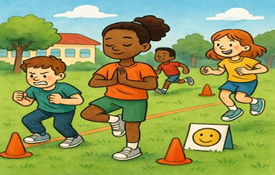
This is a station rotation/relay with emotional regulation challenges at each station, where players must practice calming techniques before they can move to the next stage. It combines physical movement with emotional self-regulation practice. The activity requires ample running space and clearly marked stations — a playground, field, or large courtyard is ideal. This physically active game supports the development of emotion regulation strategies. As children move through relay-style stations, they are faced with emotional prompts or mini-challenges that require them to recall and apply calming or coping techniques.
-
Emotional Mirror (Think-Pair-Share)
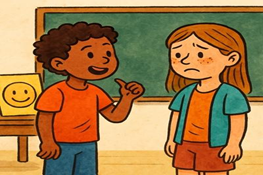
This Think-Pair-Share adaptation focuses on children mimicking, identifying, and discussing emotions with partners, helping them both recognize feelings and connect them to personal experiences. This activity works best in a quiet, well-lit room with space for students to work in pairs. Chairs can be arranged in two facing rows or scattered pairs around the room. This simple but powerful partner activity develops emotional awareness and empathy. One child expresses an emotion (verbally or through facial/body cues), and their partner mirrors it back and describes what they think the other is feeling.
-
Emotional Path (outdoor)
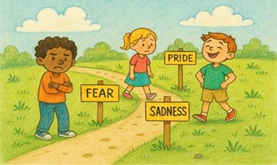
In this outdoor game, children walk along a path marked with stations, each representing a different emotion. At each station, they act out the emotion using facial expressions, body language, and verbal expressions. This activity is designed specifically for outdoor use. Choose a safe, open space like a school yard, garden, or playground path where 5–6 emotion stations can be clearly spaced apart. This physical movement activity links spatial experience to emotional awareness. As children move through a symbolic “emotional path” (marked with stations or prompts), they pause to reflect on personal emotional experiences.
-
Mindful Breathing Journey
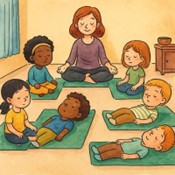
This guided mindfulness exercise helps children learn to recognize, observe, and regulate their emotions using mindful breathing and visualization techniques. This activity requires a calm, quiet indoor space with minimal distractions. A classroom with soft lighting or drawn curtains is ideal. The activity strengthens self-regulation and emotional awareness by guiding children through slow, mindful breathing accompanied by a visual or narrative journey. As children imagine moving through calming scenes (like forests, clouds, or underwater worlds), they synchronize their breathing with the rhythm of the story.
-
My Emotion Journal
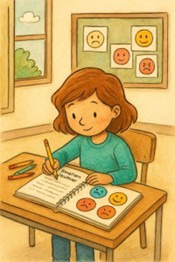
Children create their own Emotion Journal, where they regularly record how they feel, what caused it, and how they managed it, helping them track patterns and grow awareness. The activity is best conducted in a calm classroom setting, with individual desks or a seated circle arrangement. Keeping a regular journal supports emotional literacy and self-reflection. This activity allows children to record daily or weekly emotions, explore causes, and reflect on how they responded.