
Curiosity, sense of wonder and openness
Curiosity, sense of wonder and openness form a foundational skill that drives a desire to explore, learn, and understand the world. This skill represents a mindset of active interest and enthusiasm in experiencing new things, asking questions, and staying open to diverse perspectives. It is the inclination to approach situations with eagerness to learn rather than judgement, paired with an open heart and mind. This skill enables children to discover, appreciate, and reflect upon the uniqueness and complexity around them, fostering a lasting love for learning and discovery.
-
Time and Space Adventures
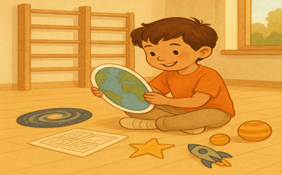
Students choose a historical period (e.g., Ancient Egypt, the Middle Ages) or a distant, exotic place (e.g., rainforest, desert, North Pole). They then take an imaginary journey there and describe, draw, or narrate what they would see and experience. activity primarily fosters curiosity, a sense of wonder, and openness. The activity develops these transversal skills by allowing students to choose a historical period or exotic place based on personal interest, the activity stimulates their intrinsic motivation and encourages them to explore unfamiliar times and cultures with openness and fascination.
-
Nature-Inspired Art
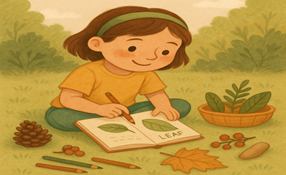
Students, accompanied by the teacher, go outside near the school (to a park, courtyard, or forest edge) to collect natural materials such as leaves, stones, branches, and seeds. Upon returning to school (or staying outdoors), they create pictures, small sculptures, land art installations, or other compositions from these materials. They then present their works to each other and discuss their experiences and impressions from the creative process. The activity helps students connect with nature through experiential learning and create original artistic expressions. The students engage in open-ended investigation, observing shapes, textures, colours, and patterns that spark new questions and ideas.
-
Mystery Box Challenge
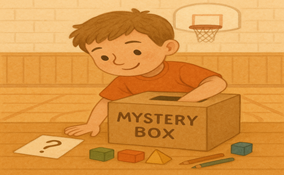
The teacher places several items of different textures, shapes, and familiarity – some familiar, some unusual – into a box. Children try to guess what the object is through touch and then come up with alternative uses for the item beyond its real function. The “Mystery Box Challenge” learning activity is cantered around sensory exploration and creative thinking. Children must identify unknown objects solely by touch and then imagine alternative uses for them. This process directly develops creativity, as it encourages children to reimagine familiar objects in new, unusual contexts.
-
Sound Exploration
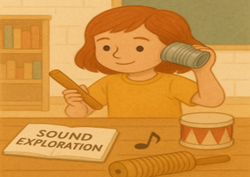
The students sit in a quiet environment with their eyes closed and listen to various sounds (e.g., birdsong, rain, train, laughter, dog barking, whispering, door slamming). Afterwards, they express what sound they heard and what emotions it evoked in them – either verbally or through drawing. There is also an opportunity for creative associations and storytelling. This learning activity primarily fosters students’ curiosity by inviting them to listen to a variety of sounds with a sense of wonder and openness. With their eyes closed, students become attentive explorers, noticing subtle details, contrasts in both familiar and unfamiliar sounds.
-
Mix and Match (Mash-Up)
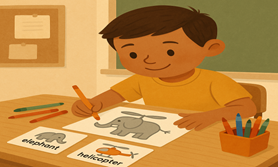
Mix and Match is a creative learning activity in which students combine two unrelated concepts – animals, objects, places, characters, materials, or abstract ideas – to invent something entirely new. The task encourages divergent thinking, flexible imagination, playful experimentation and creative explanation. Instead of simply matching words, students explore why and how two ideas can fit together, what the new mash-up could look like, and what purpose or meaning it could have. The aim is not a “funny creature,” but a creativity-driven reasoning process: invent, justify, compare, refine.