Skills-set

A set of skills necessary for a happy future was identified based on five in-depth interviews (one per partner) with cognitive child psychologists. These skills comprise ten basic skills that can be meaningfully understood and developed by 6- to 10-year-olds at this age.

  • Emotional awareness, regulation and communication

    Definition of the Skill

    Developing emotional competence is a cornerstone of promoting the well-being of children and adults. Emotional competences are broad and multifaceted, encompassing three key aspects: emotional awareness, emotion regulation, and communication of emotions. Emotional awareness is the ability to recognize and identify one’s own emotions and those of others, involving understanding personal feelings and associating them with specific experiences. Emotion regulation refers to managing emotions appropriately and productively, rather than reacting impulsively, teaching children to calm themselves, express frustration constructively, and deal with intense emotions like anger or sadness positively. Communication of emotions involves expressing feelings clearly and respectfully, verbally and non-verbally, enabling children to share what they feel, avoid misunderstandings, and build deeper connections with others. Together, these components form the basis for emotional competence, supporting personal and interpersonal growth.

    Complexity of the skill
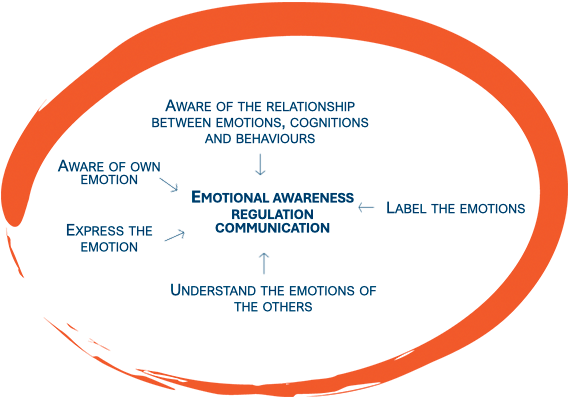
    Be aware of own emotions. It is the ability to perceive and identify own feelings and emotions quite accurately.

    Label the emotions. It is the ability to use the appropriate emotional vocabulary for the feelings and emotions experienced, labeling them correctly.

    Express the emotion appropriately to yourself and others. It is the translation of your inner world into a language others can understand, spoken not just with words, but with your body and your actions.

    Understand the emotions of the others. It is the ability to accurately perceive the emotions and feelings of the others, as well as relate from empathy by putting into practice the appropriate verbal and extraverbal language for the situation.

    Become aware of the relationship between emotions, cognitions and behavior. It is the ability to understand how emotional states influence thinking and behavior, as well as understand the influence of our ideas and behaviors on emotional states.

  • Creativity

    Definition of the skill

    Creativity is the capacity to reinterpret, combine, or expand upon existing conventions to generate ideas or approaches that are both novel and valuable. It involves combining existing knowledge, experiences, and perspectives in innovative ways to solve problems, create art, design products, or develop solutions. Creativity is often the result of collaboration, feedback, and iteration.

    Complexity of the skill

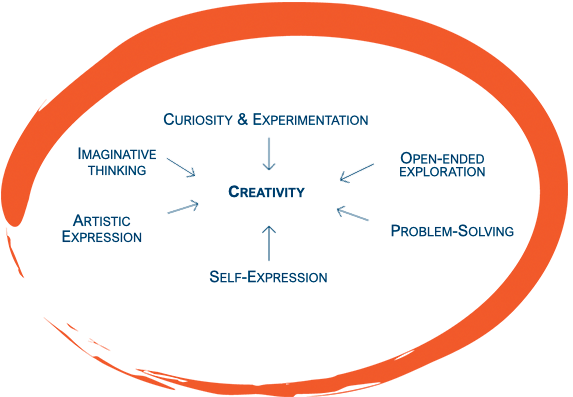
    Imaginative Thinking – Children engage in role-playing, storytelling, creating stories, characters, and make-believe scenarios.

    Open-Ended Exploration – Using materials in different ways (e.g., turning a box into a spaceship).

    Artistic Expression – Drawing, painting, sculpting, and crafting allow children to visualize their ideas

    Problem-Solving – Finding multiple solutions to a challenge.

    Self-Expression – Drawing, dancing, acting, or verbalizing ideas in original ways.

    Curiosity & Experimentation – Asking “What if?” and exploring possibilities without fear of mistakes.

  • Problem solving

    Definition of the skill

    The problem-solving process involves finding a solution to a problem by following several steps in a systematic way (= procedures or strategies). This is a structured approach to identify a problem, analyse it, and find and implement an effective solution. This skill typically transcends single disciplines and can be applied in different contexts. This skill involves critical thinking, creativity, and the ability to work through obstacles systematically. Problem-solving also requires adaptability, as not all solutions may work as expected, leading to adjustments and further exploration of alternatives.

    Complexity of the skill

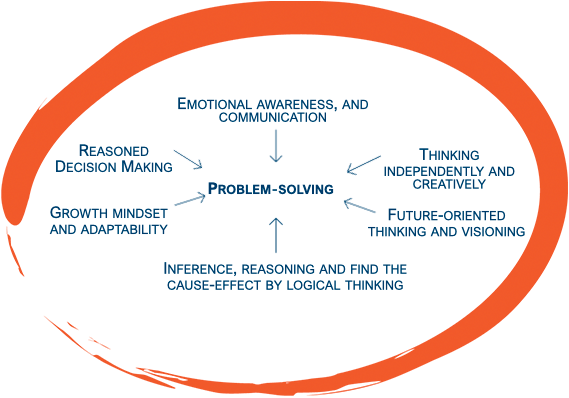
    Emotional awareness, and communication – children are motivated to solve a problem if they can recognise and verbalise why the situation is not good for them. (makes feel bad). Recognising and explaining it is an essential starting point for identifying, and solving the problem.

    Future-oriented thinking and visioning: children need to be able to imagine and articulate what a solved situation means to them. Describe the situation when the problem is really resolved. This requires “visioning” critical thinking. 

    Inferring, reasoning and finding the cause-effect: adults break down the problem, find the cause-effect relationship and identify the areas they want to change in the problem-solving process. Children need help to do it. Working together to break the problem into smaller, more manageable chunks, and finding logical connections together. However, it is important that children have the ability to understand these cause-effect relationships well. Facilitate the processes with open-ended questions.

    Thinking independently and creatively: Devise many possible solutions to all subproblems (divergent phase which involves CREATIVITY). Support children to do it. At this point, they don’t even have to have “good” solutions.

    Reasoned Decision Making: Evaluating the possible solutions and deciding which one might be most effective and solve all subproblems (convergent phase which involves CRITICAL THINKING). It includes assessing the options (pros and cons of each possible solution), weighting consequences(which solution offers the most benefits) and finally making a reasoned choice.

    Growth mindset and adaptability: Trying out a chosen solution and learning from the results, even if it doesn’t work immediately. Seek adjustments and further alternatives means that CRITICAL THINKING comes into play again in this phase.

  • Critical thinking

    Definition of the skill

    Critical thinking is the ability to reason objectively and logically, analyse and evaluate information, consider different perspectives and draw conclusions based on evidence and logic. It enables us to evaluate and assess information in an objective and systematic way. 


    Complexity of the skill

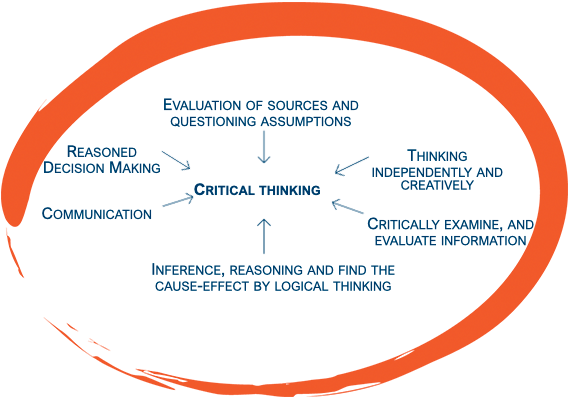
    Critically examine, analyse and evaluate information – children learn to examine new information and ideas, analyze them without pre-judgement, and form conclusions rather than just remembering facts. 

    Thinking independently and creatively about complex problems and issues, challenge assumptions, fostering independent thought. . 

    Evaluation of sources and questioning assumptions: Assessing the credibility of sources and the strength of arguments. Recognizing the motives and interests of the information provider, and considering the different perspectives of others. It relies heavily on empathy

    Inference, reasoning and find the cause-effect by logical thinking– Drawing logical conclusions based on evidence and reasoning. 
    Critical thinking needs ability to form well-reasoned opinions and positions and ensures that we do not simply believe everything we hear, see, feel or read. 

    Communiction: Sharing and recieving the information with others. Open for understanding others view. Clearly communicating the critikal thinker’s thoughts and conclusions in a logical manner.

    Self-Regulation and being objective: Acknowledging your own biases and assumptions and actively working to overcome them.

    Making independent decisions: By remaining impartial and motivated by facts rather than assumptions.

  • Resilience

    Definition of the skill

    Resilience is the ability to adapt to challenges through mental, emotional, and behavioural flexibility. It is not just a personal trait but arises from the interaction between individuals and their environment, like family, community, and society. Resilience is the process and outcome of successfully adapting to difficult or challenging life experiences, especially through mental, emotional, and behavioural flexibility and adjustment to external and internal demands. A number of factors contribute to how well people adapt to adversities, including the ways in which individuals view and engage with the world, the availability and quality of social resources, and specific coping strategies.

    Complexity of the skill

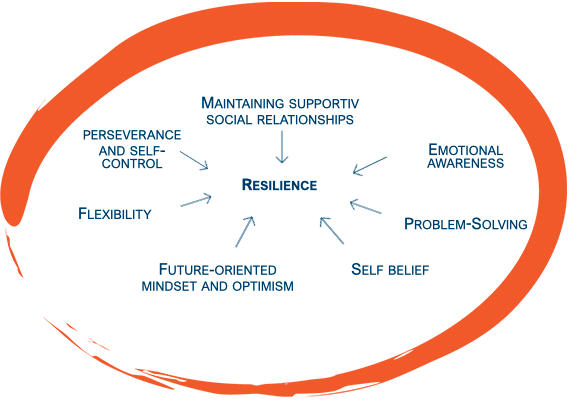
    emotional regulation and acceptance: children can calm themselves after experiencing frustration or failure (e.g., losing a game or resolving a conflict).

    self-control: in order to overcome failure and emotional pitfalls, the children must be able to establish a vision for the future (future-orientated mindset), control their thoughts and actions in order to achieve their goals, and be able to block out factors that might disturb them from reaching their goals. This requires a high degree of goal-orientation.

    problem-solving: they look for ways to overcome obstacles, like completing homework independently.

    maintaining relationships: they build and nurture supportive friendships or family bonds to help them through tough situations.

    future-oriented mindset and optimistic outlook: they remain hopeful for a positive outcome even when facing difficulties.

    flexibility: they adapt quickly to changes, such as a new teacher or classmates.

  • Flexibility

    Definition of the skill

    Flexibility is the ability to adapt to new situations and changes. It is the willingness to change. It involves being open to different ideas, adjusting to unexpected events, and finding new ways to solve problems. Flexibility is important because life is constantly changing, and being flexible allows us to cope with challenges in a calm and effective way. It’s not just about accepting change, but also being able to adjust our thoughts, emotions, and actions to meet new demands or circumstances, whether they are in our personal life, work or social environment. Flexibility helps us move forward and make the best of difficult situations. There are three skills that are very close in meaning. Sometimes they are used interchangeably, but the difference between them should be clear. These three skills are: flexibility, adaptability, and flexibility

    Resiliency is the capacity to recover quickly from difficulties.

    Flexibility is willingness to change, ability to easily modify thinking and behavioral strategies while keeping core values in mind.
    Adaptability is being able to adjust our thinking and behavior to new conditions.

    Complexity of the skill

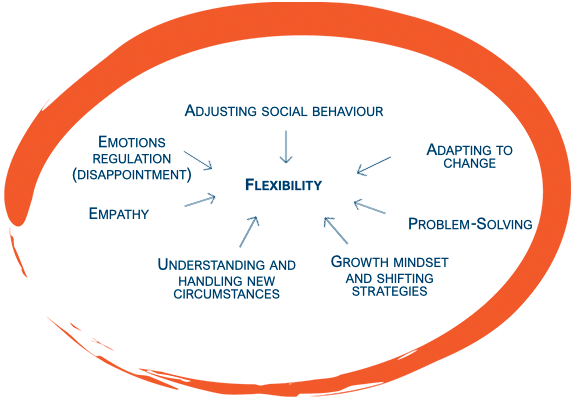
    Adapting to change: children are able to quickly adjust to new situations, like a new teacher, a change in class activities, or a different daily routine.

    Shifting strategies and handling new circumstances: when faced with difficulties, such as struggling with a task, children show flexibility by trying different approaches to solve problems, rather than giving up. The flexible children are able to adapt to unfamiliar situations, such as going to a new place or meeting new people, without becoming overly anxious or upset.

    Growth mindset and creative thinking: Flexible children are able to think in a divergent way, seeking many different, novel/unusual solutions to a situation rather than thinking in terms of one ‘good’ answer. In other words, they use their fantasy to discover new and unexpected connections and apply unconventional approaches.

    Adjusting social behaviour: children can adapt their behaviour to suit different social situations, understanding how to interact with peers or adults based on context and social norms.

    Managing emotions: if things don’t go as expected, children show flexibility by coping with the situation, adjusting their expectations, and continuing to engage with the task or situation.

  • Curiosity, sense of wonder and openness

    Definition of the skill

    Curiosity, sense of wonder and openness form a foundational skill that drives a desire to explore, learn, and understand the world. This skill represents a mindset of active interest and enthusiasm in experiencing new things, asking questions, and staying open to diverse perspectives. It is the inclination to approach situations with eagerness to learn rather than judgement, paired with an open heart and mind. This skill enables children to discover, appreciate, and reflect upon the uniqueness and complexity around them, fostering a lasting love for learning and discovery.

    Complexity of the skill

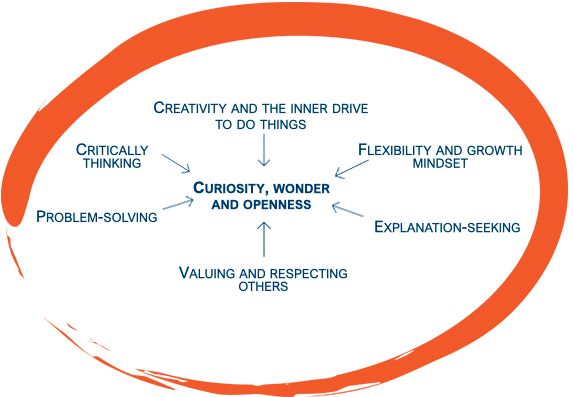
    Creativity and the inner drive to do things: Curiosity is the engine of imagination. When children wonder about something, they begin to look for new connections, come up with ideas, and see things differently. Creativity is thus directly fuelled by openness and the joy of discovery, and vice versa.

    Explanation-seeking: Children are known for asking ‘why?’ — a query motivated by their desire for explanations. Curiosity encourages children to ask questions.

    Problem-solving: Children experiment out of curiosity, trying to find connection and solutions, and this process helps them to think independently and persistently seek answers.

    Critically thinking: Openness means not only acceptance but also consideration. Curiosity drives children to ask questions, and our job is to guide them to consider multiple perspectives and distinguish facts from opinions. Thus, critical thinking can become a natural element of curiosity.

    Flexibility and growth mindset: Facing new experiences often challenges previous views. Openness is achieved when children are able to flexibly change their ideas and adapt to new evidence or perspectives.

    Valuing and respecting others: Curiosity and openness can also lead to understanding other people. When children show interest in the stories, feelings, or cultures of others, they become able to empathize and appreciate differences.

  • Empathy

    Definition of the skill

    Empathy is the ability to understand and share the emotions and viewpoints of others, putting oneself in their shoes both emotionally and cognitively. This skill is at the heart of interpersonal relationships and lays the foundation for creating a more harmonious and cooperative society. Empathy has two key dimensions:

    Emotional empathy, which refers to the capacity to feel what others feel and respond with appropriate emotions.
    Cognitive empathy, which involves understanding another person’s perspective or mental state without necessarily sharing their emotions.

    Both aspects are essential for children as they navigate complex social interactions in their personal and academic lives.

    Complexity of the skill

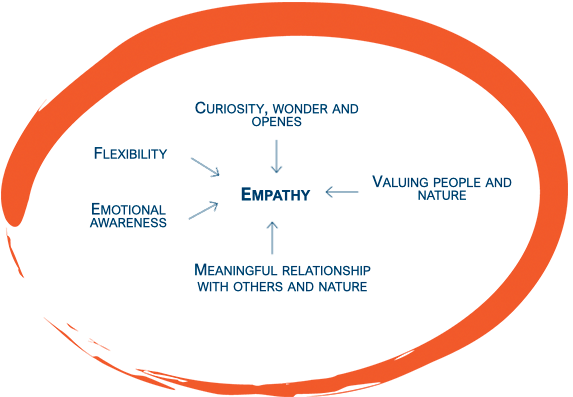
    Emotional awareness: The basis of empathy is that children are able to recognize and name their own feelings and those of others. This creates the foundation for them to respond appropriately to the feelings of others.
    Meaningful relationship building empathy requires quality social relationships because it helps children form deeper bonds, making them aware that they themselves are part of a community and enabling them to listen to and understand each other.
    Valuing people and nature: for children to have empathy for others, they need to learn to respect and appreciate differences between people, whether their feelings, thoughts or cultures. This attitude can also extend to nature. Children will wonder at the diversity of the living world, and in doing so they will develop a more responsible, caring relationship.
    Curiosity, wonder and openness: true empathy can only develop if children are open and curious about the stories, perspectives and feelings of others. Inquiry promotes attentive listening and understanding.
    Flexibility: being empathetic also means that children are able to put aside their own perspective and see the situation from the other’s point of view. This requires emotional flexibility.

  • Valuing people and nature

    Definition of the skill

    Valuing People and Nature is the skill of recognising the intrinsic worth of both human beings and the natural environment. This involves understanding the interconnectedness between human well-being and the health of the planet. It includes a conceptual and procedural grasp of sustainable development as essential for a thriving future. This skill promotes respect for ecosystems, responsible resource use, and a balanced relationship between people and nature, which are crucial for long-term sustainability and societal well-being. Beyond awareness, valuing people and nature requires taking responsibility and transforming values into concrete actions that nurture and protect both humanity and the planet, ensuring a sustainable legacy for future generations.

    Complexity of the skill

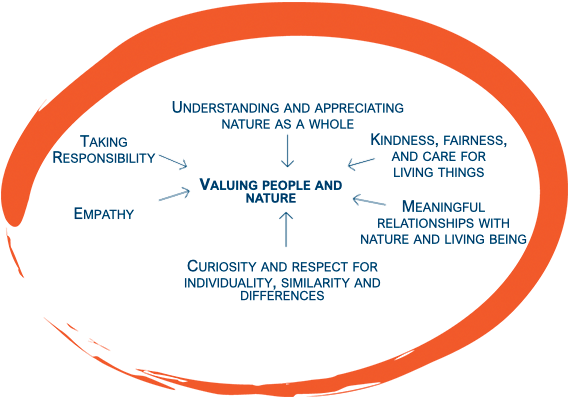
    Understanding and appreciating nature as a whole: The feeling that all living beings belong together and that humans are part of nature and they form a a wholeness.

    Empathy: This is a critical element of children’s relationship with nature and other people, which can be developed through interactions with the natural world and other people.

    Meaningful relationships with nature and living being: Cultivating a healthy relationship with the natural environment, the community and individual to awaken in children a feeling of connectedness.

    Curriosity and respect for Individuality, similarity and differences: Children are naturally curious. This natural curiosity and respect can easily be extended to the needs and rights of other Living Beings and Nature through interactions with the natural world and other people. This respect is often expressed in actions such as sharing and helping.

    Kindness, fairness, and care for living things: Showing compassion and consideration for others, and a willingness to act individualy or/and in collaborating in teams for the benefit of others (including nature).

    Taking Responsibility: Children practice responsibility in small ways, such as recycling or caring for pets or plants. These actions nurture a sense of duty toward their community and the environment.

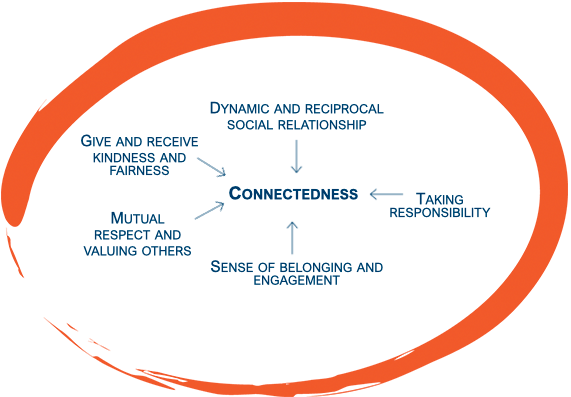
  • Connectedness

    Definition of the skill

    Connectedness is the ability to recognize and engage with the broader community, both locally and globally. It goes beyond sociability and collegiality, embracing a sense of shared humanity and responsibility. This interconnectedness is shaped by relationships through communication, travel, migration, trade, and political systems. On a cognitive level, connectedness involves understanding global, regional, national, and local issues, while recognizing the interdependence of different countries and populations. Socio-emotionally, it involves empathy, solidarity, and respect for diversity. Behaviorally, it means taking actions that promote peace, sustainability, and social cohesion, fostering environments where people care for one another.

    Complexity of the skill

    Awareness and Curiosity: Children begin to notice differences in people, cultures, and the environment. They grasp concepts of fairness, kindness, and responsibility toward others and nature.

    Mutual respect and valuing others: Through activities like role-playing and group work, children learn to respect and valuing others’ feelings, backgrounds, the nature and the environment. This respect often shows in actions like sharing and helping.

    Sence of belonging and engagement: Want to feel linked with others, a group of people(peers, family, community, school), linked and being a part (and responsible and act) of something larger than oneself.

    Dynamic and reciprocal relationship: It is very important for children to love and feel loved. We teach them that they are important and that they should consider others important too. This is characterized by understanding and sensitivity to the feelings and beliefs of others, and vice versa, the same for themselves.

    Taking Responsibility: Children practice responsibility in small ways, such as recycling or caring for pets or plants. These actions nurture a sense of duty toward their community and the environment.