
Duration: 90 minutes.
Primary SPIRIT Skill(s) focus
- Creativity
- Flexibility
- Resilience
Brief description
On land (forest), in water, and in the air – from the perspective of chosen story characters or creatures
- Preparation – Group formation, arranging materials
- Recalling the chosen story
- Real and imaginary locations: land, water, air
- Inspiration and ideas: technical preparation for the creative process
- Playful activity to spark imagination
- Creative group work
- Discussion, reflection, closure.
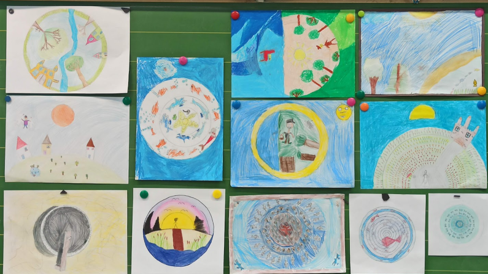
How does this develop particular SPIRIT skills?
Collaborative artistic creation – based on the perspectives of story characters chosen by the students – offers children the opportunity to imagine new situations, view familiar stories from different angles, and adapt flexibly to a creative challenge. This directly supports the development of flexibility, as students must adapt to each other’s ideas, a shared group concept, and any changes that arise during the creative process.
Resilience – the ability to cope with challenges – also develops on multiple levels during the activity. Re-immersing in the story world, tackling unfamiliar situations (e.g., “How does a bird or a fish see the forest?”), and managing disagreements during group work all help strengthen internal flexibility, emotional regulation, and problem-solving thinking.
Throughout the task, students:
- Step into the perspective of different creatures, enhancing empathy and mental flexibility;
- Adapt to a shared creative space and group dynamics, developing flexibility through real-life cooperation;
- Seek creative solutions to both technical and interpersonal challenges;
- Practice perseverance, learning how to keep going even when something doesn’t work out immediately.
- Visual and spatial creation is a particularly effective tool for stimulating flexible thinking and inner resources at this age. It allows for playful, symbolic, and free expression, while also supporting the emotional and cognitive processing of experiences.
- The final group discussion and reflection further reinforce self-awareness and self-regulation, as students share their experiences and insights from the creative process.
What do we want to achieve regarding SPIRIT skill development (student understanding and/or behaviour)?
The goal of this activity is for students to develop their adaptability and emotional resilience through collaborative creative work based on a story. During the group task, they are encouraged to explore different perspectives, cooperate with one another, seek solutions, and respond creatively to emerging challenges. Through this engaging, experience-based activity, children can discover how to activate their inner resources when facing new situations.
- Students will be able to adapt to group dynamics and respond flexibly to differing ideas and viewpoints during the creative process.
- They will experience that making mistakes or changing a previously chosen solution is a natural part of collaboration and creation.
- They will learn to accept others’ perspectives and make shared decisions within the group while working toward a common creative goal.
- Students will practice handling difficulties (e.g. lack of ideas, differing opinions) with calmness and patience.
- They will recognize the value of their own contributions, which will strengthen their self-confidence and inner stability.
- Students will understand that differing solutions can enrich the final outcome, and that flexibility can be a valuable resource in the creative process.
- By stepping into the shoes of a chosen story character, students will learn to see problems from new perspectives, helping them develop a more flexible attitude in their own real-life situations.
Academic/Curriculum Objective connection
- Development of visual perception and creative skills
- Understanding the meaning and aesthetic message of visual imagery
- Familiarization with visual expression methods and illustration techniques
- Practice in visual representation of both imaginary (fairy tale) and real spaces and environments
- Observation and use of the visual characteristics of nature (earth, water, air), where relevant
- Visual interpretation of the story’s plot and characters
- Strengthening interest in and appreciation for cultural values (if applicable)
- Development of empathy, imagination, and visual thinking
- Enhancing cooperation skills through group creation.
Materials and tools needed for implementation
- Large sheets of wrapping paper, drawing paper, or cardboard (one per group)
- Coloured pencils, felt-tip pens, wax crayons, oil pastels
- Tempera or watercolour paints (optional), brushes, water containers, cloth or paper towels
- Glue, scissors (if collage or cut-and-paste work is included)
- Pre-cut templates, textures, images (e.g., animals, landscape elements – as needed)
- Newspapers or plastic sheets to protect the floor (if students are working on the ground)
- Floor space or tables large enough to comfortably accommodate the groups
- Text of the fairy tale (or visual aids representing story elements – optional)
- Illustrative images of natural environments: forest, water, sky (e.g., cards, posters, or digital projections – as needed)
- Time-keeping device (clock, bell, etc.)
Preparation notes
- Pre-planning group formation helps ensure smooth work and harmonious collaboration. It is advisable to mix students with different abilities and temperaments in each group.
- Prepare all necessary materials and tools in advance and arrange them in an easily accessible place so students can reach them without difficulty.
- Provide an appropriate workspace; for artwork done on the floor, it is recommended to protect the floor with newspaper or plastic sheeting.
- Keep the recall of the chosen story brief and focused so that students’ memories of the plot and characters remain fresh.
- Prepare visualisation aids (pictures, cards, templates) to support imagination and perspective-taking.
- Plan and time the instructions and imagination-stimulating playful exercises that support group work, to maintain motivation throughout the activity.
- Consider that students work at different paces; allow enough time not only for the creative process but also for sharing and group reflection.
- Maintain a positive atmosphere; encourage students to realise their ideas and engage in open communication.
- Be prepared for possible technical issues and have backup materials ready (e.g., pencils, paper)
Guided Questions
- How can you imagine and represent the different settings of the story (land, water, air) from your own perspective?
- What creatures or characters might live in each environment? What qualities help them survive or go on adventures?
- How can you share your ideas together as a team so that everyone contributes to the creation?
- What happens if an idea doesn’t work out or the group’s work turns out differently than expected? How can you handle this?
- How can you adapt if someone else imagines the scene or viewpoint differently?
- What do you do if difficulties or conflicts arise within the group? How can you support each other?
- What was it like to see the story from a different perspective? Did it help you understand the characters or situations better?
Stage Debriefing Questions (Optional)
- What challenges did you encounter during the creative work, and how did you manage to solve them?
- How did you manage to adapt to your group members’ ideas or changes?
- Did you feel that despite the difficulties, you were able to work together and realize your ideas?
- What did you learn about how to respond flexibly to an unexpected situation or change?
- From what new perspective were you able to see the story’s world and characters? Did this help you understand the story better?
- What was your favourite part of the creative process, and why?
- What would you take with you from this collaborative work to help you solve future situations or work in groups?
Tips and Tricks for dealing with stage challenges
- Group members cannot agree. Careful planning is needed before the activity. It is important to select the appropriate paper size and consider the composition and size of the groups. Appointing group leaders can help facilitate cooperation.
- No ideas. Creating a storytelling, inspiring atmosphere can help spark imagination more easily. During preparation, showing examples and highlighting creative solutions is recommended. If necessary, individual support can be provided to specific groups.
- Too many ideas. It is advisable to set a time limit for deciding which idea to implement. Valuable ideas that cannot be completed due to time constraints can be realized at a later occasion.
- The group is too loud. Playing relaxing music can help promote focused, calm work and maintain concentration.
- Uncertainty in using tools. Only use tools that students are already confident with to avoid uncertainty and tension.
- Problems with representation. Maintaining a relaxed, accepting atmosphere is important, where attempts are supported and there is room for restarting. Using templates or examples can make the task easier and boost self-confidence.