
Contents
- 1 Brief description, and rules of the game
- 2 Indoor/Outdoor Classroom layout notes
- 3 How does this game develop the primary skill?
- 4 What do we want to achieve regarding primary skill development (student understanding and/or behaviour)?
- 5 Suggested use, and practical examples
- 6 Materials and tools needed for implementation
- 7 Guiding questions
- 8 Tips and Tricks for dealing with challenges
- 9 Difficulty level tailoring
- 10 Debriefing and reflection questions
-
Brief description, and rules of the game
Starting from the centre of the playing field, starting lines are marked approximately 1 meter away in both directions, and boundary lines are marked about 10 meters away. (The starting positions can be adjusted according to the available space.).
Skill focus
Primary Skill Focus
- Resilience
Complementary/Secondary Skill Focus
- Emotional awareness (emotional regulation and communication)
- Empathy
- Flexibility
- Problem-solving
Age group Student number Duration 6+ class size 5-10 minutes How to play – brief game rules
Two teams are formed, named BLACK and WHITE. The teams take their positions behind the starting lines, facing each other. After the teams are formed, the opponents line up facing each other along the dividing strip between the two halves of the field, placing one foot slightly forward, ready to run.
The game leader’s task is to call out the team names irregularly, for example: “White!”
Then the WHITE team chases the BLACK team, but they may only run up to the boundary line of the opposing half. Thus, any “black” player who crosses the boundary line is safe. The white team members who manage to catch black players on the black team’s side bring them over and add them to their own team as whites.
If the game leader calls “Black!”, then naturally the white team must run away from the black team. (Besides calling “Black” and “White,” the game leader may sometimes call other colour names to confuse the teams.)
The game is won by the team that manages to absorb all the players of the opposing team into their own.
A more difficult variation is played when the two halves are separated not by a strip but by a single line. This requires faster reactions to the calls: “Black!” or “White!”
Game Rules:
- Roles alternate between chaser and runner, based on the game leader’s decision.
- The called team becomes the chaser.
- Tagging is only valid before the boundary line.
- If a runner steps out of bounds at the sideline, it counts as if they were tagged.
- If a runner has already stepped into their safe zone with one foot, a tag is no longer valid.
- A chaser may tag multiple runners in a single round.
- The team that absorbs all members of the opposing team wins.
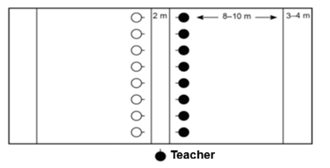
Playing area
-
Indoor/Outdoor Classroom layout notes
The game can be played indoors in a gym or outdoors, during physical education lessons or leisure activities.
-
How does this game develop the primary skill?
During the game, children encounter constantly changing situations: sometimes they are chasers, other times runners, or they may even switch to the opposing team. The game requires quick adaptation, immediate reaction to decision-making situations, and the ability to accept changes that occur during the game – for example, suddenly “losing” a teammate or moving to the opposing team themselves.
During the game, children:
- Process experiences of failure (e.g., being caught or failing to catch anyone).
- Learn to rebuild their motivation when they return to the game or take on a new role.
- React quickly to changing situations (e.g., unexpected team name calls).
- Experience the balance between risk-taking and self-control (e.g., how far they dare to advance while in danger).
- Reframe defeat as not an end but the beginning of a new role.
From the perspective of resilience, the game is particularly effective in normalizing mistakes and providing opportunities for quick processing and moving past them – all within a playful, safe environment.
-
What do we want to achieve regarding primary skill development (student understanding and/or behaviour)?
As a result of the activity, students:
- Become capable of flexibly adapting to unexpected or rapidly changing situations.
- Learn to re-engage after failures or difficulties (e.g., being caught, switching teams).
- Develop emotional self-regulation, especially during more tense game moments.
- Develop a more positive attitude toward mistakes and experience that they can be learning opportunities.
- Practice decision-making even under uncertain conditions.
- Strengthen their cooperation skills and the sense of belonging to the community.
-
Suggested use, and practical examples
The Black-White Tag Game is a competitive, dynamic game played with two teams, featuring rapid changes and unpredictable role switches. It requires a large playing area and can be played on a sports field, in a gym, or outdoors. During the game, children get used to frequently adapting to new situations and must pay attention both to the game leader and to each other.
It is recommended to play the game regularly throughout the school year, gradually increasing the difficulty. The number of players and the size of the available space also affect the game’s dynamics. Rules can be modified to suit specific goals.
-
Materials and tools needed for implementation
None.
-
Guiding questions
Due to the active nature of the game, there is no opportunity to ask questions during play, except for questions aimed at understanding the rules
-
Tips and Tricks for dealing with challenges
- Challenge: Students have difficulty understanding the rules.
Tip: Provide visual examples demonstrating key movements and typical situations during the game. - Challenge: Not all children are motivated.
Tip: Create exciting names for the main actions of the game that spark their imagination, helping them engage more easily. - Challenge: Children have trouble keeping up with the changing roles.
Tip: Simplify the game by removing the misleading colour calls, using only “Black” and “White” as cues. - Challenge: Some players become overly excited, which can create safety risks.
Tip: Temporarily ask the overexcited player to observe the game from outside for a while. - Challenge: Children struggle to cope when they are caught or have to switch teams.
Tip: Emphasize that failure or role change is not final, but an opportunity for learning and growth.
- Challenge: Students have difficulty understanding the rules.
-
Difficulty level tailoring
The Black-and-White Tag Game can be played in multiple versions with varying difficulty levels. Based on the group composition and prior knowledge, the teacher can modify the rules to make the game easier or more challenging.
Beginners (6-7 years old): This version is recommended for 6-8-year-olds and whole classes. A central dividing strip marks the two teams’ sides of the playing field. The teacher forms the teams. The team colours are clearly displayed on each side, making the players’ positions obvious. At the start of each round, the teacher announces the chasing team’s name and raises a flag of the same colour. The start of each round is signalled simultaneously with an audible and visual cue. The game leader provides continuous positive reinforcement and allows children to share their opinions at the end of the game. Initially, only black and white colours are used; later, other colours can be introduced as a misleading element.
Advanced learners (8-9 years old): This version is recommended for 6-10-year-olds and whole classes. Visual cues can be omitted as needed; rules are explained verbally. Team leaders can be selected by drawing lots, which also determines the team names and which team starts. The teacher leads the game. In addition to the basic rules, different game modes can be tried, for example:
- “Prisoner capture” mode, where every caught player joins the chasing team.
- “Elimination” mode, where caught players wait outside the playing area until the next round.
- Multi-round point-scoring game, with fixed team compositions; points are tallied by the game leader based on caught players.
- Players can start from different positions (cross-legged sitting, lying on the stomach, kneeling, lying on the back).
After the game, the teacher invites children to share which situations made the game more exciting for them, highlighting good solutions and different play styles.
Experts (9–10 years old): This version is recommended for 8-10-year-olds, played with a whole class. The playing field is marked only by a dividing line instead of a strip, requiring faster reactions. Besides team leaders, a game leader can be appointed from among the students. All versions from previous levels can be played here as well, with additions such as players lining up back-to-back and having to suddenly turn to chase the opposing team. It is important that the game mode is chosen together with the group, allowing opportunities to try new variations.
-
Debriefing and reflection questions
- What feelings did you have when you were caught or had to switch teams?
- How did you manage to rejoin the game after being caught or experiencing failure?
- What strategies did you use to respond quickly to the game leader’s calls?
- How did teammates support each other during the game?
- What did you learn about handling unexpected situations and changes?
- What would you say to a friend who feels disappointed during the game?
- In what ways did you change by the end of the game regarding perseverance or cooperation?