
1. EVOLUTION OF STEAM EDUCATION
To cultivate the competencies central to the SPIRIT framework, it is essential to understand the foundation and evolution of STEAM education. STEM—Science, Technology, Engineering, and Mathematics—emerged as a formal educational framework in 2001, when the acronym was coined by leaders at the US National Science Foundation. However, discussions about strengthening these disciplines in education had begun years earlier, driven by concerns about student performance and future workforce readiness. The impetus for STEM education arose from international assessments such as TIMSS (Trends in International Mathematics and Science Study) and PISA (Programme for International Student Assessment), which revealed significant gaps in student achievement. These findings sparked urgent conversations about educational reform, not only to improve academic outcomes but also to address declining interest in STEM careers. Policymakers recognized that these trends posed risks to economic competitiveness and innovation capacity on both national and global scales. In response, nations worldwide began realigning their educational systems, emphasizing interdisciplinary approaches that connect classroom learning to authentic, real-world challenges.
Within the SPIRIT project, STEAM education serves as a powerful vehicle for developing the ten transversal skills essential for children’s future well-being. What distinguishes STEAM from traditional subject-based instruction is its emphasis on integration and application. Rather than treating Science, Technology, Engineering, Arts, and Mathematics as isolated domains, STEAM weaves them together through hands-on, inquiry-based experiences that mirror the complexity of real-world problems. This approach naturally cultivates critical thinking, creativity, collaboration, and several other transversal skills that align directly with the SPIRIT framework’s vision for preparing children to navigate an uncertain and rapidly changing future. In essence, STEAM education embodies a holistic approach to learning that extends beyond academic achievement. It equips children with both knowledge and competencies while fostering a mindset oriented toward innovation, empathy, and problem-solving. As outlined in the SPIRIT framework, this interdisciplinary methodology creates natural opportunities for children aged 6-10 to develop the transversal skills that will serve them throughout their lives. Through STEAM, learning becomes active, meaningful, and connected to the real world—preparing children not merely to succeed in school but to thrive as adaptable, resilient, and creative individuals in an interconnected global society with balance.
2. STEAM LESSON APPROACHES – ADDRESSING VERSATILITY IN APPROACHES
Educators engaging with STEAM education quickly encounter a landscape marked by diversity and adaptability. This variety stems partly from the evolving nature of the field itself. The term has proven remarkably flexible, giving rise to variations such as STEAM (STEM + Arts), STREAM (STEM + Arts + Reading/Research), and even STEMM (STEM + Medicine).
Beyond definitional variations, STEAM approaches differ in their degree of disciplinary integration. Four levels of integration are identified:
- Disciplinary (subjects taught separately),
- Multidisciplinary (subjects taught in parallel around a common theme),
- Interdisciplinary (subjects merged with blurred boundaries), and
- Transdisciplinary (subjects fully integrated around real-world problems).
These levels represent a continuum, offering educators flexibility in designing learning experiences that suit their students’ developmental stages and curricular contexts.
Despite this diversity, a unifying principle underlies all effective STEAM education: the rigorous academic concepts are coupled with real-world lessons as students apply science, technology, engineering, and mathematics in contexts that make connections between school, community, work, and the global enterprise.”
Within the SPIRIT project, we embrace this diversity and adaptability while maintaining a clear focus on skill development. The STEAM programs provided by the consortium reflect this versatility—educators will encounter different approaches, each designed to foster transversal competencies while addressing varied learning objectives and classroom contexts. Some activities emphasize exploration and inquiry; others focus on design and prototyping. Some integrate all five STEAM disciplines; others highlight connections between two or three. Some of the programs among the tools that have been developed apply the STEAM approach to outdoor education and focus more on nature connection, valuing nature and people, hands-on activities, dirty learning, etc., in addition to the subject-related connection. This flexibility is intentional, allowing teachers to select approaches that align with their students’ developmental levels, school’s pedagogical vision, and the specific skills they wish to cultivate.
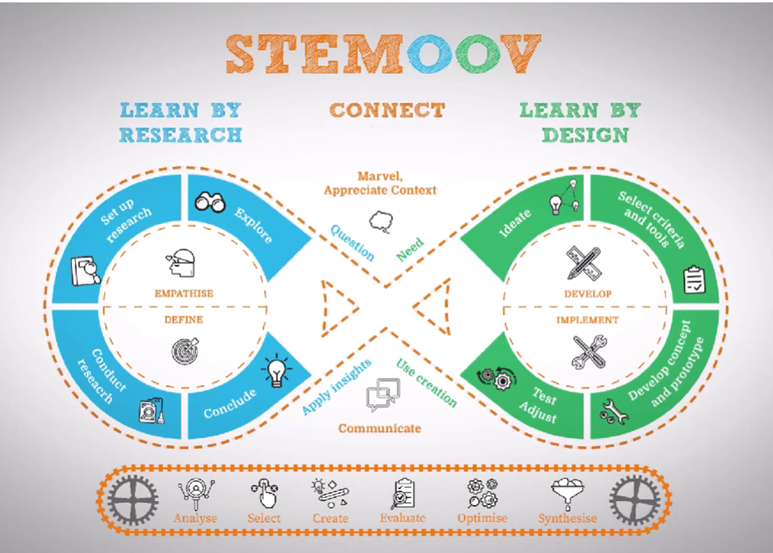
A noteworthy educational approach to STEAM Education is the STEMOOVIE approach, developed by educators in Belgium which exemplifies one particularly robust framework for structuring STEAM learning experiences . STEMOOVIE places dynamic research and design processes at its center, recognizing that authentic learning occurs through cycles of investigation, creation, testing, and refinement. The model comprises three interconnected components:
- Learning by Research enables students to acquire insights and develop critical mindsets through systematic investigation. Students formulate questions, gather information, design experiments, make predictions, conduct observations, and draw evidence-based conclusions. Importantly, this process is iterative rather than linear – students may revisit earlier steps as new questions emerge.
- Learning by Design empowers students to transform ideas into tangible prototypes. Beginning with brainstorming and ideation, students’ progress through planning, creating, testing, and refining their solutions. This phase emphasizes creativity, problem-solving, and resilience as students encounter challenges and iterate toward improvement.
- Connect serves as both the engine and glue of the STEMOOVIE model. This dimension links students to their real-world environment, to each other through collaboration, and to the higher-order cognitive skills they develop during STEAM activities. Connection ensures that learning extends beyond the classroom, fostering relevance and meaningful engagement.
All STEAM approaches are used by SPIRIT partners resonate powerfully with Kolb’s Learning Cycle, which the SPIRIT handbook identifies as essential for developing transversal skills. Kolb’s cycle comprises four stages: Concrete Experience, Reflective Observation, Abstract Conceptualization, and Active Experimentation. Each stage supports the development of behavioural competencies in young learners.
- Concrete Experience corresponds with the initial engagement phase of STEAM activities. Students encounter hands-on challenges—planting seeds, building structures, investigating phenomena—that require them to exercise teamwork, empathy, problem-solving, and resilience. For example, when students work together to design an automatic plant watering system, they immediately experience the demands of collaboration and creative thinking.
- Reflective Observation follows naturally as teachers guide students to discuss their experiences. Questions such as “How did you feel during the activity?” or “What strategies helped your team succeed?” encourage students to examine their emotional responses and interpersonal dynamics. In the STEMOOVIE model, this reflection occurs organically as students evaluate why their prototypes succeeded or failed, prompting them to consider alternative approaches.
- Abstract Conceptualization involves connecting specific experiences to broader principles. Teachers help students recognize patterns and name the skills they are developing. For instance, after a design challenge, educators might introduce vocabulary related to problem-solving steps or teamwork strategies, creating a shared language that students can apply across contexts. This phase mirrors the moments in STEMOOVIE when students move from observing a specific outcome to understanding underlying principles, such as how moisture sensors function or why certain materials behave in particular ways.
- Active Experimentation occurs when students apply their learning to new situations. In STEAM contexts, this manifests as iterative testing and refinement—students adjust their designs, try alternative materials, or tackle new challenges using strategies they have developed. This phase embodies the growth mindset central to the SPIRIT framework, encouraging students to view setbacks as opportunities for learning rather than failures.
By recognizing the alignment between the STEAM approach and Kolb’s experiential learning framework, educators can appreciate how STEAM activities naturally support the development of transversal skills. The STEAM approach emphasizes active engagement, reflection, conceptual understanding, and iterative application—precisely the conditions under which children aged 6-10 develop lasting competencies and SPIRIT skills.ent, but accompany students in training skills that will enable them to successfully face personal, professional, and social challenges, making a real difference in their growth.
While STEAM education encompasses diverse approaches and methodologies, the SPIRIT project identifies four core parameters that define high-quality STEAM learning experiences. These parameters ensure that activities not only engage students intellectually but also cultivate the transversal skills essential for future well-being. Every STEAM activity within the SPIRIT framework is designed around these interconnected dimensions:
- Connection to the Real World: Authentic learning occurs when students perceive relevance beyond the classroom. STEAM activities grounded in real-world contexts—investigating local environmental issues, designing solutions to community challenges, or exploring phenomena students encounter in daily life—foster motivation and meaningful engagement. This connection also develops the SPIRIT skill of connectedness, helping children recognize their role within broader social and ecological systems.
- Connection to Research and Inquiry-Based Learning: Curiosity drives deep learning. STEAM activities invite students to formulate questions, investigate phenomena, gather evidence, and draw conclusions. This inquiry stance nurtures critical thinking, flexibility, and the sense of wonder that fuels lifelong learning. Rather than passively receiving information, students actively construct understanding through exploration and discovery.
- Motivating Learners to Engage Actively: Effective STEAM activities spark intrinsic motivation. Through hands-on challenges, creative problem-solving, and opportunities for collaboration, students become invested in their learning. Activities that offer choice, allow for multiple solution paths, and provide tangible outcomes naturally engage children’s interest and encourage persistence. This active participation builds resilience and self-efficacy as students see themselves as capable problem-solvers and creators.
- Development of Transversal Skills—Particularly the 10 SPIRIT Skills: While content knowledge matters, the primary purpose of SPIRIT STEAM activities is skill development. Every activity intentionally creates opportunities for students to practice and refine emotional regulation, creativity, problem-solving, critical thinking, resilience, flexibility, curiosity, empathy, valuing people and nature, and connectedness. These competencies emerge naturally through collaborative challenges, design iterations, reflective discussions, and the authentic application of knowledge to meaningful problems.
These four parameters form the SPIRIT STEAM Core—the foundation upon which all exemplary STEAM learning experiences rest. In the sections that follow, we will explore how this core translates into educational practice, examining both the skill development potential and the curricular integration possibilities that make STEAM such a powerful pedagogical approach within the SPIRIT framework.
4. INTEGRATING TRANSVERSAL SKILL DEVELOPMENT
Transversal skills are the core of the SPIRIT project, and STEAM education is a uniquely rich medium for developing them through authentic, interdisciplinary challenges. These cognitive, social, and emotional capacities—often called soft, life, or 21st-century skills—help learners collaborate, adapt, and navigate complexity, remaining valuable long after specific content changes.
The SPIRIT framework identifies ten essential transversal skills for children aged 6-10, each crucial for future well-being in an uncertain world. STEAM education offers unique pathways for developing each of these competencies:
Emotional Awareness, Regulation, and Communication: STEAM activities create emotionally rich collaborative experiences where students encounter frustration when prototypes fail, excitement when solutions work, and must communicate feelings constructively while navigating group dynamics and setbacks.
Creativity: STEAM challenges require divergent thinking and novel problem-solving through open-ended design tasks that have multiple viable solutions, encouraging students to generate original ideas, combine concepts unexpectedly, and express thinking through diverse modalities including artistic, verbal, and kinesthetic forms.
Problem-Solving: The engineering design cycle at STEAM’s core explicitly teaches systematic problem-solving as students define challenges, gather information, generate solutions, test ideas, analyse results, and refine approaches through iterative cycles.
Critical Thinking: STEAM’s inquiry-based investigations cultivate analytical reasoning as students design fair tests, control variables, interpret data, evaluate evidence against criteria, distinguish reliable information from speculation, and form evidence-based conclusions.
Resilience: The iterative design process ensures students regularly encounter failure as structures collapse and predictions prove incorrect, reframing setbacks as essential learning opportunities while building tolerance for frustration and persistence through challenge.
Flexibility: STEAM’s open-ended challenges demand adaptability as unexpected results requires revised hypotheses, initial designs need pivoting to alternative solutions, and collaboration with peers necessitates remaining open to different perspectives and approaches.
Curiosity, Sense of Wonder, and Openness: STEAM activities begin with phenomena that genuinely spark interest—investigating why objects float, exploring how bridges hold weight, discovering how plants respond to environments—tapping into children’s natural wonder while the Arts component reveals beauty in patterns and concepts, connecting intellectual understanding with aesthetic appreciation.
Empathy: Collaborative STEAM work requires attending to teammates’ ideas and recognizing peers’ emotions, while activities addressing real-world problems like designing assistive devices or investigating environmental impacts prompt students to consider diverse human needs and experiences.
Valuing People and Nature: STEAM investigations of ecosystems, environmental phenomena, and sustainability develop ecological awareness and appreciation for nature’s complexity, while collaborative challenges teach students to recognize and celebrate diverse contributions as they experience how complementary talents strengthen collective work. Placing STEAM activities in an outdoor environment – “Dirty STEAM Learning” -, the direct integration of STEAM activities into nature, explicitly boosts the development of green and sustainability competences, the exploration of the relationship between nature and humans, and the awareness that all creatures of nature are interdependent and part of a single universe.
Connectedness: STEAM’s interdisciplinary nature reveals how Science, Technology, Engineering, Arts, and Mathematics interweave in authentic contexts, while investigations of local environmental issues, global technologies, and cross-cultural innovations help students recognize relationships among people, communities (local, national and global), and natural systems rather than viewing knowledge or existence as isolated fragments.
Understanding how STEAM activities naturally foster these competencies helps educators facilitate with intentionality. By recognizing moments when skills emerge—when a failed test offers a resilience-building opportunity, when diverse team ideas create space for empathy and flexibility, when surprising results spark curiosity—teachers can use strategic questions and reflective prompts to make skill development explicit, helping students recognize and name the competencies they’re practicing so these skills transfer to new contexts beyond the STEAM activity itself.
5. INTEGRATING CONTENT AND CURRICULUM
While skill development forms the primary focus of the SPIRIT project, educators understandably wonder how STEAM activities integrate with mandatory curricular content and learning objectives. A common concern is that STEAM approaches, however valuable for skill development, may divert precious instructional time from required academic material. However, this concern rests on a false dichotomy. High-quality STEAM education does not require choosing between skills and content; rather, it provides a powerful vehicle for achieving both simultaneously.
STEAM activities inherently address rigorous academic concepts across multiple disciplines. When students investigate plant growth, they engage deeply with life science curriculum standards related to organisms and environments. When designing bridges, they apply mathematical concepts.
A project investigating water quality might simultaneously engage students in scientific investigation skills, mathematical data collection and graphing, literacy research and writing, technological tool use, and artistic communication of findings. This integration allows teachers to address diverse curricular requirements efficiently while providing students with the holistic, contextualized learning that supports deep understanding and retention.
The versatility of STEAM approaches allows teachers to adapt the framework to their specific curricular needs, student interests, and available resources. A teacher focusing on geometry might engage students in designing architectural models. A teacher exploring cultural studies might facilitate students’ creation of artistic and engineering artifacts reflecting different societies’ innovations. The common thread is not specific content but rather the interdisciplinary, inquiry-based, design-oriented approach that characterizes STEAM learning.
Furthermore, STEAM education directly responds to the reality that our world operates interdisciplinarily. Professional scientists collaborate with engineers, artists, and mathematicians. Community challenges require integrated knowledge from multiple domains. Global issues like climate change, public health, and technological ethics demand citizens who think across disciplinary boundaries and recognize complex interconnections. By providing students with educational experiences that mirror this interdisciplinary reality, STEAM prepares them not merely for school success but for meaningful participation in contemporary society.
For educators committed to the SPIRIT framework’s vision of preparing children for an uncertain future, STEAM education offers a coherent pedagogical approach that honours both academic rigor and skill development. The activities provided by the SPIRIT consortium demonstrate this balance, each designed to engage students in substantive content learning while creating authentic opportunities to develop the ten SPIRIT skills. As teachers explore these activities, they will discover that investing time in STEAM approaches yields rich dividends: students who are not only knowledgeable but also curious, creative, resilient, empathetic, and equipped to navigate the complex challenges of the 21st century.