
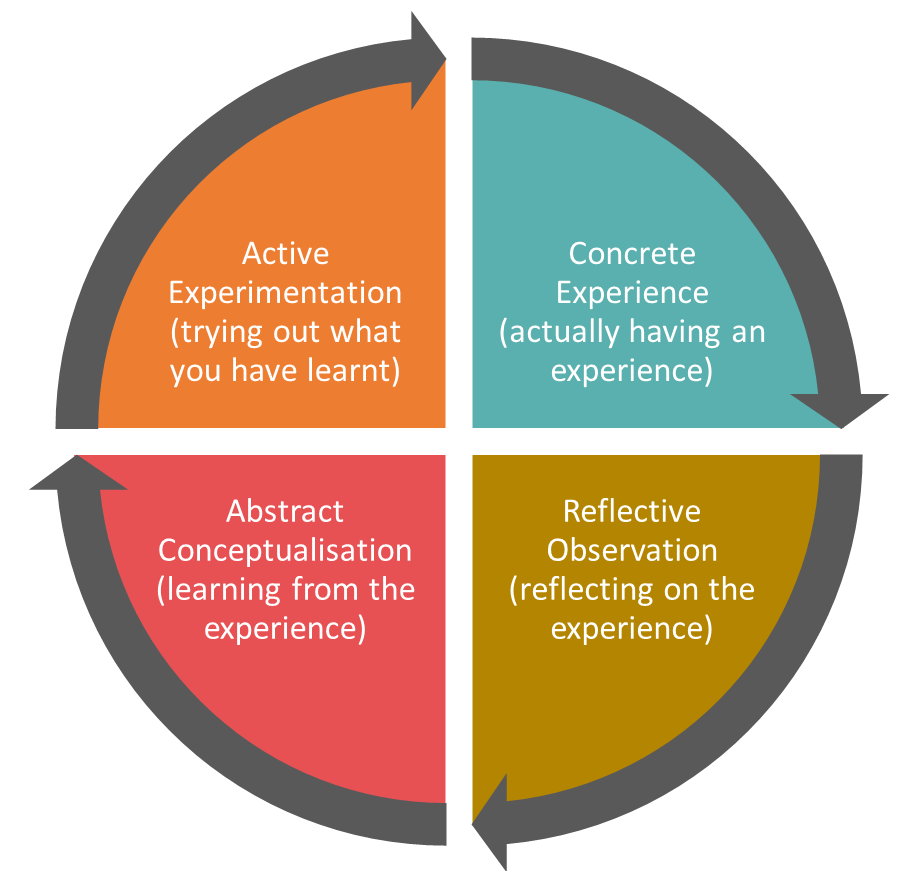
Teaching transversal skills in primary schools is essential to help children develop social and emotional competencies that will serve them throughout their lives. Yet teaching transversal skills skills is certainly different from teaching curriculum subjects: the development of transversal skills involves an understanding of the competence itself, (observing and naming it) and the development of functional behavioural habits. To ensure an effective learning experience, teachers can structure their approach using Kolb’s Learning Cycle, which consists of four key stages: Concrete Experience, Reflective Observation, Abstract Conceptualization, and Active Experimentation. Each stage plays a crucial role in developing behavioural competencies in young learners and can be used in different periods of the learning process: anyway, we believe that, for a complete transversal skills learning experience, each stage should be used.
Concrete Experience
This stage involves engaging children in activities where they can experience transversal skills firsthand. Since young students learn best through direct engagement, teachers should create practical scenarios that encourage behaviours like teamwork, empathy, problem-solving, and resilience. Activities such as role-playing, collaborative games, and storytelling exercises can provide meaningful experiences where students naturally encounter challenges that require soft skills to navigate. For example, to foster teamwork and problem-solving, the teacher can propose a hands-on group task where students need to cooperate to achieve a common goal using limited materials.
This type of collaborative challenge encourages communication, negotiation, and shared decision-making. Similarly, to help develop empathy, students could be guided to imagine and discuss how others might feel in various situations, encouraging perspective-taking and emotional awareness.
Reflective Observation
After participating in an activity, children need to reflect on what happened. At this stage, teachers should guide students in discussing their experiences by asking questions like: How did you feel during the activity? What worked well? What was difficult? This process helps students recognize the impact
of their behaviour and emotions, fostering self-awareness and a deeper understanding of interpersonal dynamics. Teachers can use group discussions, drawing exercises, or personal storytelling to help students process their experiences in a way that suits their developmental level.
After the collaborative group task, the teacher can facilitate a reflection session, inviting students to share what strategies they used to work together, how they felt during moments of disagreement, and what they could do differently next time. To support younger students, teachers could also introduce simple visual tools where students place markers to indicate how they felt at different points, helping them connect emotions to specific experiences.
Abstract Conceptualization
Once students have reflected on their experiences, they need to connect these insights to broader concepts and principles of transversal skills. At this stage, teachers should introduce structured explanations, models, and real-life examples to deepen understanding. For instance, if a child struggled with teamwork, a teacher might explain the importance of communication and listening skills and illustrate these with a relatable story or a simple diagram. This step ensures that students not only recognize soft skills in action but also understand their value in daily life. Teachers could consolidate these reflections by creating a visual class chart where students contribute ideas on what helps good teamwork, communication, and empathy. Linking their personal experiences to broader principles helps children see patterns across different situations and develop strategies they can apply in the future. To further support this process, it is important to nominalize key concepts related to soft skills – for example, explicitly naming the steps involved in problem-solving (identifying the problem, brainstorming possible solutions, evaluating options, choosing a solution, and reviewing the outcome). This practice helps students develop a clear, shared language to describe the skills they are using, so that they can master them better in all the contexts in which they will come across.
Active Experimentation
The final stage involves applying newly learned concepts in different situations. Teachers should create opportunities for students to practice transversal skills in real-life classroom interactions. Group projects, peer mentoring, or classroom responsibilities can provide spaces for students to test and refine their interpersonal skills. Encouraging students to set small goals, such as sharing more with classmates or resolving conflicts calmly, helps them integrate soft skills into their everyday behaviour. For example, teachers could assign small group tasks or rotating classroom responsibilities where students need to work together and make decisions as a team. Regular check-ins can help students reflect on their progress and identify what helps them collaborate more effectively. In cases where conflicts arise, students can be supported with structured conversation prompts to guide them through resolving disagreements constructively.
By following Kolb’s Learning Cycle, teachers can ensure that students experience, reflect on, understand, and apply transversal skills effectively. This structured approach allows children to develop crucial behavioural competencies in a natural and engaging way, fostering social-emotional growth that will benefit them throughout their lives.